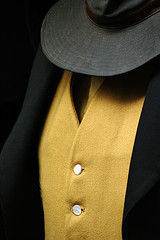
An Unlikely Appeal

What do you think of when you think of the 1920’s and 1930’s in America? I think of what a lot of us would probably consider to be the marks of the essence of the era: classy dress, big band music, swinging jazz, and gangsters with tommy guns in violin cases. The image of the gangster with the wide-brimmed hat, in fact, continues to be the stereotypical image of the gangster today, pervasive in games like Mafia Wars, and influencing comic book villains. There’s something about the action of speak-easies and federal law enforcement trying to capture villains who have committed atrocities such as the St. Valentine’s Day Massacre that appeals to our storytelling.

Similarly, I remember my father’s fascination with Westerns. I grew up with episodes of Gunsmoke periodically looping in the background. The U.S. Marshal staring down the villain who was doing evil in his town, and ultimately winning in the street because he was the faster draw: That was my father’s idea of a good adventure.

Still today, I’m attracted to a certain amount of action in my escapist entertainment. For me, it’s espionage and spy stories, complete with their fair share of blowing up secret bases and foiling plans to take over the world. Or, just a good dose of come-uppance to the ethically depraved, as delivered ala Jason Bourne.

Yet, when I designed the set for a 1930’s noir style murder mystery show in college, the focus wasn’t on violence, but art deco and glamorous costumes. The entire show had no tommy guns or gangsters to be found, yet was as quintessential of the time period as any other production. Similarly, a tour of the International Spy Museum will tell you that the lives of spies are frequently quite without action, contrary to the assassinations and car chases portrayed in film. And, while the Wild West was wild, it was more so the wildness of the survival struggle between man and the elements, rather that pistols in the street at sunset.

My point is that, for some reason, we find the introduction of violence onto these stories and time periods to be addictive, even glamorous. Lives of daring adventure, in which one’s life might end at any turn, draws viewers and readers into the tale, although they are poor representations of historical accuracy. Which leads me to wonder: why is this sort of violence attractive to us?

In fact, any time I’m confronted with violence in storytelling that draws me into the story, I’m a bit amazed. I say that because, philosophically and theologically, I’m a pacifist. That is, I don’t think violence is ever a good answer to a problem. That being the case, why does it draw me into the movie theatre the same as any of my friends? I’d like to think that I’m not susceptible to this, but I obviously am.

Of course, my diet isn’t a steady intake of action films or James Bond novels. And, there is a point where too much is too much. I wonder if this attraction exists in Eastern cultures as much as it does in the West, or even if it is as pervasive in the rest of the West as it is in the U.S.?

Perhaps we’re all wanting the lifestyles of adventure that break us out of our day-to-day routines? Perhaps we all wish we were a bit more than we are. more heroic? In fact, maybe this plays into the nature of a hero somehow. I’d love to hear your thoughts.

Photo Attribution: fabbio

The Nature of a Hero, Part II

I’m sort of continuing my thoughts on the nature of a hero, here, with some reaction to a recent comic book issue.

Leading up to this summer’s Avengers film, Marvel is publishing a line of one-shots called Avengers: Origins. While the art in most of the issues has been a bit stylistic for my taste, I’ve enjoyed the stories, which are simple re-tellings of the backgrounds of the heroes comprising the Avengers as they appear in Marvel comics (a larger cast of characters than will appear in the film, which will star only the most well-known of the core characters). I only dabbled in the Avengers titles when I was younger, and never collected them seriously, so these stories have been instructional for me.

I’ve purchased them a bit out of order, and the most recent issue I’ve read is Avengers Origins: Luke Cage. I remember Luke Cage as Power Man when he, partnered with Iron Fist, comprised Heroes for Hire.  I was unaware of his origin story. A former gang-banger from Harlem is what looks like the 1980’s, Cage spends time is prison after being framed for a crime he didn’t commit, although he had committed his share. A victim of racist treatment in prison, he volunteers for an experiment that is intentionally botched by a guard who hates him, and endows him with amazing physical strength and near invulnerability. Cage escapes with these powers, and returns to the life he knows: committing crimes in order to survive, all the while plotting revenge for the old friend who had framed him. During one of these criminal ventures, he witnesses an elderly security officer paralyzed as a result of his actions, and flees with this haunting him.

Ultimately, Cage discovers that he can, in fact, use his abilities for good, and decides to profit off of this as “hero for hire.” His actions haunt him, though, and he spends the next several years unable to see himself as a hero, and attempting to make restitution for his actions, until he is finally forgiven by the paralyzed security officer. Only then does he recognize himself as a hero.

Of course, comic history shows us that Cage goes on to become one of Marvel’s more well-known heroes as Power Man. This story resonated with me because it shows a different aspect of the nature of a hero: the hero who has turned from evil to do good. There’s something almost mythological in this: the street-wise fighter who knows the ways of evil but chooses to eschew them for good, bursting through the darkness in a massive display of power to save the day. There’s something amazing about the hero who has previously been on the wrong side of the law, and then repented of their wrongs and moved to a life of restoration. Theologically, this would be repentance: a changing of one’s mind, an intentional turning of one’s life in the direction of good after recognizing the evil.

Of course, not every hero comes from such a background. This isn’t a necessary qualification, although many heroes have experienced some degree of darkness in their lives before becoming a hero.

So, when confronted with the epiphany that the way a villain has been using his or her powers for evil, if that villain changes their course and chooses to do good instead, then they are no longer a villain. They are a hero. And these heroes appreciate second chances, because they’ve received one of their own. Cage escaped his prison sentence, to never be re-discovered. He chose to be a hero in his new life, and thus experienced a sort of cultural forgiveness. Again, this is a theological concept: one who has been forgiven of much, will show greater love to those around them. And this, ultimately, is what a hero does: he or she shows love to those around them, by placing their own lives at risk to save those who cannot save themselves.

I’m not sure how this plays into my fictional explorations of the nature of a hero, but it must somehow, because I think that this is as critical as it is inspiring.

Photo Attribution: Zach Dischner 

Cuts Both Ways

I heard a story on Monday morning listening to the BBC in the car. Of course, I can’t find it anywhere, now, but the story sparked a strong reaction from me. The story was an interview with an editor that makes his life’s work of abridging fiction, most notably the classics. His stated reason for doing this during the interview was because attention spans in our culture are decreasing rapidly, seeming to infer that most people don’t have the patience or motivation to read a full length literary novel.

My knee-jerk reaction was not a pleasant one.

Now, a more thought-out response. Abridging is nothing new in the world of fiction. I don’t read abridged fiction in written form, but I occasionally read it in audio form. Whenever we travel by car, Karen and I listen to audiobooks. Depending on the nature of the trip, and on the genre, I haven’t been opposed to buying abridged audio versions. Typically, though, these are genre novels, not literary novels. Sometimes, though, I’m amazed at just how condensed the books are, and sometimes the abridged novels accomplish what an editor seems to have missed the opportunity to accomplish.

We’ve all read books in which the author became a bit verbose in descriptions of mundane details…books in which we find ourselves thinking, “was it really necessary to know the full and minute details of every meal that character ate in a week?” Worse, when you read this during a murder mystery, you find yourself taking copious notes of minutiae in case it becomes a critical factor in determining “whodunit,” only to find out that these facts had nothing to do with the story.

I’m all about character development, but every author makes the mistake of spending too much time describing some things, and not enough time describing others. Sometimes that makes it into the book.    Larsson, for example, strays a bit into verbose-ness in the Millenium trilogy. To give an example of the unabridged vs. the abridged versions of Larsson’s work: the abridged audio version of The Girl with the Dragon Tattoo weighs in at just under 8 hours; the unabridged version of The Girl who Played with Fire was nearly 19 hours of audio.

So, perhaps I’m being verbose in saying all that, but I’m pointing out that abridging fiction isn’t necessarily a bad thing.

Still.

I think the issue is motivation. To abridge a novel, especially a classic work of fiction, because the attention span of the average individual is too short to handle reading a full length novel, is problematic. The reason is because it is catering to the symptoms of a problem…adapting to a dysfunction…rather than working to solve the problem, to address it. The fact that the average person doesn’t read a book for pleasure in a year, or that their fractured attention span won’t permit them to focus on anything more than the length of the average Twitter update, is an issue that needs to be solved.

Which leaves us with two possible alternatives at a basic level: admit that stunted attention spans is a problem that needs to be addressed, or pretend that its acceptable instead of wrong and re-adjust our lives around it.

So, I could abridge my post here by saying that hacking up works of classic fiction in order to cater to the psychological trauma done to the average reader by a media-saturated culture is wrong. Classic literary authors are considered such for a reason. Their works were crafted the way they exist for a reason. To cut appendages off of them because we in our judgement deem them “too long” is tragic. Those texts, which frequently have been foundational to our culture, deserve more respect than to carve them into pieces.

Just so we can multi-task better while saying we’ve read them.

140-character thoughts have their place. So do 50,000 word ideas. We need to be able to engage, and appreciate, both.

Photo Attribution: misteraitch 

Everyman

There was a point in the history of Western culture in which it was fashionable for everyone to keep a journal. In our new age of social networking, journaling is, of course, more popular than ever…its just that we want everyone else to see our thoughts, instead of keeping them private. We invite their comments. We want their opinions. We want to challenge their opinions. Thus, nearly everyone I know posts status updates somewhere. They share links to the things that interest them. Whether in the compact form of Twitter, the more creative palette of Tumblr, or the long-form written expression of a blog, we’re all about letting everyone else see our thoughts.

Blogging, of course, has brought about its own debates in the cultural sphere. Specifically, we wonder, are the blogs of anyone who witnesses a specific event and decides to publish the details as they witnessed them to be considered journalism? Most bloggers are not trained journalists, and neither are most social networkers…yet its not an exaggeration to say that we learn news from Twitter more quickly than any formal news media outlet. And, news media outlets are making it much easier to post eye-witness video and accounts to their websites.

Of course, this doesn’t necessarily include the so-called “elites.” No direct eye-witness accounts or opinions of Joe Public in the pages of the New Yorker, for example, or the bylines of the Washington Post. Some publications and media hold to a higher standard. They want to be gate-keepers, filtering what goes through their sites to their readers and viewers. Societies have always, and likely will always, have these elites.

Yet, our information age has brought about a new distaste for the elites in favor of the common person. Not only is it easier to find out what someone just like us thinks about a situation, but it is also possible for any of us to publish our own books, record and produce our own albums, shoot our own films, and then to circulate them to a worldwide audience. Albeit a small worldwide audience at first, but…you never know what will go viral tomorrow.

Interesting, isn’t it, how this invention of the Internet has brought about a lack of tolerance for the elite gatekeepers? We are no longer as interested in what the publishing houses and record labels think is worthy music. We want to hear the album made by the guy on the other end of town that just posted his first music video on YouTube, or read the novel self-published by the author we’ve connected with on Twitter.

Yet, we still respect the elite in most areas. When push comes to shove, we trust a news report from the New York Times over a more amateur news blog. We value a degree from an Ivy League institution over an online school. We respect great literature over a print-on-demand novel. There’s value to the excellence brought about by people who have a reputation for doing it the best, yet there’s value to the fact that anyone can do it.

So, where’s the reconciliation of this conundrum? I respect novels published with well-known publishers. I respect authors who self-publish, and, in fact, intend to self-publish some of my own work in the near future. That’s where it hits home for me. Writing, musicianship, acting, film directing, are all difficult crafts that require much work to achieve any level of competency or excellence. Yet, all of these gifts can fall by the wayside, regardless of their level of excellence, because of business decisions based on executive profit or the lowest common denominator of the audience instead of the quality of the art.

Do you read self-published books? Watch independent films? Listen to indie bands? The technology is there for these artists to do excellent work, and the information pipeline is there for them to distribute it as they please, without working in connection with agents or executives. This is an exciting time to be creative. Ironically, I wonder if the so-called “entertainment industry” will implode, or at least be forced to alter drastically, as a result?

And, I wonder if it would be such a bad thing if it did?

Photo Attribution: goXunReviews

A Game Changer

As Thanksgiving Day festivities (read: I ate entirely too much food) drew to a close late last night, I was in a conversation with a family member about video games. Some of the family were leaving a couple of hours from that time to arrive at a Back Friday sale at midnight to pick up a video game that has, apparently, been long anticipated by gamers. We talked about how I’ve always sort of found video games to be time-wasters, and that I’ve always had better things to do with my time. Its not that I think gamers are weird or anything…I have a lot of friends that are gamers. And while I was heavily into role-playing games like Dungeons and Dragons when I was young, video games just aren’t anything that have ever interested me.

The other family members in the conversation, though, offered a different perspective. They find video games to be interactive storytelling. They describe detailed world-building, beautiful artwork, and an experience that is never the same twice, because the player will make different decisions that alter the outcome of the story in different ways…not dissimilar to the Choose Your Own Adventure books of old.

This intrigued me, because this is similar to the theatre experience. Live performances are never the same twice. Different plays are interpreted differently by different directors and actors. The same cast will experience completely different performances on different nights because of different audiences, the reactions of whom are necessary for the complete experience, and alter each play considerably.

So, I thought, if you view video games in this light, then they begin to look like very legitimate forms of art: in the words of my family member, a form of storytelling with “more depth.” In fact, I think of schools with MFA in creative writing programs that offer coursework in writing for games.

So, to complete my education, the family pointed me toward some video samples of some of their favorite games.

Storytelling? Sounds interesting to me. And, just to appreciate the artistry of the worlds that are built for these games, I was impressed by the detail and the beauty of this one:

I was thinking about the wealth of creative talent involved in this last clip: the digital animators, the musicians, the voice actors, the writers, the post-production technicians. This is on par with an animated short, at least. And when I think about writing a story with so many possible twists and turns that can change with interactivity, I suddenly find myself very appreciative of the specific skills required.

So, while I doubt seriously that I’ll ever become a gamer, and while I’m still troubled by the many cases of video game addiction that can plague those who invest too much time these worlds, I’m thinking that this possibility exists with any creative endeavor, and any participation in alternate fictional worlds. That doesn’t, I suppose, make the participation itself a bad thing. So, the result of my 2011 Thanksgiving holiday is to find a new appreciation for the art of video games.

Learning something new is a beautiful thing.