A Review of “Performing the Sacred: Theology and Theatre in Dialogue”

Performing the Sacred: Theology and Theatre in Dialogue (Engaging Culture)Performing the Sacred: Theology and Theatre in Dialogue by Todd E. Johnson
My rating: 4 of 5 stars

“”Performing the Sacred” is written as a dialogue, alternating chapters between a theologian and a theatre artist. This is a more contemporary, and significantly more accessible, installment to the canon of work on theo-dramatics, and focuses on application rather than new theory. As a result, there really isn’t any new theological ground covered here. What the authors do well, however, is synthesize existing sources into a cohesive whole for a modern intersection of theology and theatre.

Of course,  I’m immediately fascinated by interdisciplinary work, and this is no exception. Savidge’s history of theatre’s interaction with the institution of the Church is thorough, though unfortunately written in a somewhat dry and academic tone. Ironically, Johnson’s theological discussion is written in a more lively tone, and is just as thorough. Both interact not only with previous modern discussion in the theo-dramatic canon (such as Harris’ “Theatre and Incarnation”), but also with such theological greats as Tillich and Kierkegaard, as well as working through the philosophical underpinning of Plato and Tertullian, and how these thinkers have impacted the theatrical arts.

Johnson identifies three theological components of theatre: incarnation, community, and presence. Again, the thought here is not drastically new for anyone who has read any theological treatments of theatre previously. What Savidge and Johnson do, however, is speak to the modern implications of this thought. The biggest take-away for me by far is the argument to the higher validity of theatre over more “virtual” arts (such as streaming media, or even film and television). The authors argue, rightfully, that the substance level of most television programming is not only far inferior to theatre, but also loses effectiveness in becoming an imitation of a more real event, in the way that speaking with someone face-to-face is more real and conducive to good communication than is a phone conversation. Thus, theatre is always more real an event than film or television, because an audience interacts with a theatrical performance in a manner that makes each performance unique. This is accomplished because the performers are present in the same space as the audience. The only aspect of this throught process that I find to be problematic is that film and television are not entirely vacuous, and good art exists in both mediums. The authors almost leave the reader with the impression that both are forever inferior to theatre. Also problematic is established rhetorical theory that claims an observer of any static artwork forever alters both the work and themselves. However, in fairness to the authors, the implied superiority of theatre that I mention is just that: implied; it is never overtly stated and the book does not leave room to treat the issue at length.

I found the final chapters a bit prescriptive at times, but thought provoking overall, for both artists active in the theatre, as well as any person of faith engaging with theatre from the audience.

Anyone with a theological bent would find this book informative, especially if he/she has not explored the intersection of theology and theatre before, in which case this book is very readable and will provide you with a launching point and direction for deeper reading.  Any theatre artist who is practicing from a faith-informed worldview will appreciate this book as well. Slightly academic, but still a good read, and worth having on your shelf.

View all my reviews

You can purchase “Performing the Sacred” here.

Across the Aisle

I’m a firm believer that whenever people cross disciplinary lines to accomplish any sort of task, especially for the greater good, that everyone wins.

Following a fantastic experience at an applied theatre conference a few weeks ago, I presented some ideas to a group of clinicians this week about using theatrical techniques to work with individuals on the autism spectrum. The clinicians were engaged, ideas started flowing, and everyone just broke out of their shell and had fun! This topic is just an example of how this idea of interdisciplinarity works, and there is beginning to be evidence-based, peer-reviewed studies regarding the success of this particular collaboration.

In Entertainment Theology: New-Edge Spirituality in a Digital Democracy, Barry Taylor says it this way: “…no field of study stands alone or apart. The present situation is one in which old categories have been dissolved and boundaries separating fields of study have been erased” (p. 201). I’ve witnessed this to be true in my experience. Universities are beginning to launch graduate programs in interdisciplinary studies, and established schools within those universities are beginning to launch interdisciplinary programs of study within their own schools, bringing in students with research interests launched from different disciplines to contribute to the whole in a better way.

Since the Industrial Revolution, our professional expertise has become increasingly compartmentalized. In doing so, we’ve isolated ourselves from those in other disciplines, focusing so intently on the mathematics that we forget the value of the literature, or so pragmatically on the pharmacy that we forget the contributions of music. The actor has something valuable to bring to the psychologist’s practice, as does the psychologist to the actor’s craft. We can’t, of course, discount the idea of being a specialist in a specific field…the idea of being the best at what you do…but we can’t forget to talk to each other in doing so, either.

In fact, if we continue to take the concept of interdisciplinary discussion seriously, I think some really good things will begin to manifest. A mutual respect of everyone for their unique skills, knowledge, and passions, for example. More people will know about more things, which removes some of the unnecessary elitism of knowledge in certain areas that permit some to take advantage of others. Mutual respect leads to more open and civil discourse, something that the U.S. could certainly use more of. When we begin to see, as Taylor states, that none of our fields stands alone or apart, we begin to realize that we actually need each other…that we don’t stand alone. When we recognize that we need each other, we become more civil with each other.

Imagine, civility and mutual respect. Who knows where that might lead?

Helping Fellow Artists

It’s very important for the creative community to support each other, especially in the Internet era. Since at least the Renaissance, the arts have functioned primarily on a patronage system: those with money who appreciated the arts financially supported the work of artists in whom they believed. Some of what we consider to be the greatest works of art in human history have been funded or commissioned by patrons. Our economic structure doesn’t really support creative projects, in the sense that many artists struggle to find finances to support projects that they are passionate about…and which often have something important to contribute to our culture. Of course, some artistic mediums are more expensive than others. Film and music recording happen to be among them.

And it just so happens that I know an artist in each of these mediums who are trying to fund important projects. 
There are some platforms out there that work on the patronage system. The concept is that artists post their projects, and contributors who find themselves attracted to a project make a contribution to support the work. A lot of people who have only a couple of dollars to spare and who like a project can fund it to completion…and, of course, the artist gives a special “thank you” of some sort to support those who contribute. 
I think these sites are great ideas, and I am seriously considering using one of them myself at some point in the future to cover some research expenses for a novel. Currently, though, I’d love for you to check out my friends’ projects, and see if you might be interested in tossing in something to help them create their passions. 
John is trying fund a film entitled The Happiest Place on Earth. I’ve been privileged to read the script at various stages of its evolution, and I believe in the project, because it has something important to say. You can find his project on IndieGoGo. 
Renee has an EP under her belt, and needs to finance the studio time for a full album, What I Need, this summer. I’ve been there through the development of many of her songs (and the stories behind them), and, honestly, I just like her vocals. You can find her project on Kickstarter. 
No more solicitations for now, I promise! Have a great weekend! 

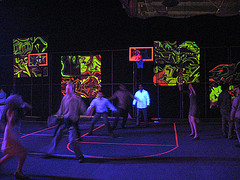
House Lights and Hoops

Over a dinner party with friends Monday evening, the conversation turned to athletics. Specifically, college basketball, and the commentary and analysis of Charles Barkley. A friend thinks his analysis of the game is incredibly in-depth and deserving of respect. I’ve never been able to stand Barkley, from the first time I saw him play to the time he retired from the Phoenix Suns. I suppose I was never really interested in his commentary. He just irritated me. My friend says that that he projects a “tough guy” image, but that he is very good as a commentator.

Sort of a character in a play.

When I was an undergrad student and incredibly involved in nearly every production that came down the line in my theatre program, I discovered that I was a bit of an anomaly amongst my fellow theatre students, because I enjoyed watching sports. Specifically, I liked professional basketball. I wore Orlando Magic t-shirts. They had difficulty understanding why, and I had difficulty communicating the theatrical thrill of the opening introductions of the players (light show included) through the (hopefully) nail-biting close calls and amazing shots that kept me glued to the screen.

I realized, even at the time, that learning to love basketball was a way to connect with my father. He had played basketball through high school and in college, and we had difficulty understanding each other. He didn’t really get the theatre thing, but he tried very, very hard, for my sake. I thought the least I could do was to work toward an interest in basketball, as a way to connect with him. It worked. It was the launching point for a renewed relationship with my father.

I haven’t watched basketball since a few years ago, around my first semester of grad school, I think, when the L.A. Lakers had an historic starting lineup and couldn’t pull out a championship season. I determined then that it had become about the individual players, and not the love of the game. Sort of like how a prima donna ruins a production by robbing the play’s cast of its camaraderie. In any cast, I haven’t really watched professional basketball since. Perhaps not so coincidentally, neither has my father.

I don’t think I’m all that odd for being a “creative type” that enjoys athletics (I’m still a big tennis fan). In fact, I have many artist friends who follow various athletic seasons with much more intensity than myself. I’ve theorized that there’s a theatrical quality to athletic competition, something deeper than just spectacle. The spectacle, though, was okay in itself, and I didn’t explore the thoughts too deeply.

Todd Johnson solidified my theory that athletic events are, in fact, theatrical. The drama of the competition is, of course, the reason that those of us who watch sports are engaged (I’ve come up off of the sofa yelling at many a buzzer-beating shot in my life). Johnson says that this is framed, though, in the larger context of the story…the “through-line,” if you will…behind the game. Michael Jordan’s incredible game winning shot was incredible in itself, but stunning against the backdrop that it won the game at the last minute, and that it was the last game of his career (well, until he returned from retirement), and that he had succeeded despite the family tragedy he had experienced. Johnson says that this story is told through the commentary surrounding the actual competition of the game, and attributes this to the explosion in popularity of various sports commentary media outlets in recent years. I think this is also why many sports fans remember specific games like we remember great movies or plays, looking back to a particular performance with great nostalgia. Following the stories can have a positive impact on the audience, such as my relationship with my father. Participating in the story builds a camaraderie that is easily equivalent to the cast and crew of a play.

So my love of watching basketball was no contradiction to my theatrical bent. I was simply a spectator to a different type of theatre, one that told the drama of fellow humans in the same time but a different space, rather than fictional characters. I’ve always suspected that theatre explains a great deal of life. This just goes to prove that point.

Photo Attribution: ToastyKen

A Second Viewing of the Third Watch

Third Watch: The Complete Second SeasonSometimes, its amazing what you see when you look at something the second time.

Or watch something the second time, as the case may be. Several years ago, a television series called Third Watch grabbed my attention. In case you’ve never become familiar with the series, it was a drama based on the lives of police officers, firefighters, and EMTs working the third watch (the evening shift) in New York City. This was really good television, capturing what first responders deal with  each day, and how it impacts their personal lives. The show appeared before September 11th…that is, it aired from 1999, before programs about first responders were as fashionable. It continued through, and long after, September 11th, going on to win a Peabody Award, among other critical acclaim.

I think that I was attracted to the show because I briefly entertained the idea that I wanted to work in law enforcement when I finished college (go ahead…laugh). While law enforcement has rightfully held its place as an interest and not a career choice for me, I’ve always had a soft spot for police dramas. They’re sort of a guilty pleasure. I recognized Third Watch, from when I first enjoyed the series until it tragically ended while I was in grad school in 2005, as great drama, and well acted.

I was either too busy to see the depth of the writing, or else my rhetorical skills just weren’t developed well for television viewing, in the show’s early years. I recently re-discovered the show through Netflix, and began watching season 2 again. There’s some fascinating writing at play, here.

The over-arching theme of the program, at least in its beginning, was everyone’s need for a hero. From the opening credit music (a techno piece called “Keep Hope Alive” by The Crystal Method), the viewer is set up to realize his/her need for a hero, for someone to come to their rescue when the worst occurs. We are then introduced to the real-life heroes of the first responders, those who risk their own safety to help those they don’t know. The heroism is depicted is well-shot, edge-of-your-seat action sequences that come from nowhere and end just as abruptly…just as though we were experiencing them in real life. The first responders sweep in and save the day, and we see their camaraderie develop as they have to deal with what they’ve experienced. We see this camaraderie grow even more when they don’t manage to save the day, despite their best efforts.

Season 2, however, opens with a series of episodes dedicated to specific characters. In these episodes, we are walked through how each character’s personal struggles and flaws have a reciprocal effect on how they do their jobs, and what their jobs do to them. We see a paramedic who gets into trouble because he can’t reconcile an ideal with the reality of racism he sees (and sometimes imposes over reality) around him. We see a police officer who can’t make ends meet financially, and lies to her husband and her partner to cover an abortion because of her fear that she can’t afford another child. We see a police officer haunted by his deceased father’s infidelity, and a paramedic who stands precariously on the edge of instability in her longing to put her failed marriage back together.

These episodes are interesting, because they present the heroes as not only very human, but sometimes very questionable in their motivations. Later in season 2, in an episode called “Know Thyself,” one of the police officers tells another, “Sometimes the things that make you a good cop make you a bad person.” The heroes we turn to in our time of need, those who we rely on to make us safe, are unable to be heroes out of any sort of pure benevolence. Even when they are close to the ideal, their own lives are crumbling when they are not “in costume,” as it were, as heroes. Thus, Third Watch assumes a theme similar in many ways to The Watchmen, in that we are presented with a sort of anti-hero; each doing their best, but hopelessly tainted by the very evil they fight.

The episodes dealing with individual characters’ struggles move into a gripping episode early in season 2 called “After Hours.” In the beginning of the episode, the characters have arrived on the scene of a fiery car accident, seconds too late to prevent the vehicle from exploding and all of its occupants dying. Despite their hidden grief, life moves on, and the shift ends. After the shift, groups of them (characters we haven’t previously seen spend time together outside of work) go out, some for coffee and some for alcohol, in an effort to cope with what they have seen. One gets hopelessly intoxicated, one tries to sleep with another, one drives recklessly through the streets in his muscle car, returning to the scene of the accident. All of them encounter teenagers in their outings. The teenagers help them in some cases, and in other cases they lead them into situations that they are able to affect positively (two of the off-duty police officers are able to intervene in a mugging while walking a girl unsuccessful in catching a bus home through the park). One officer, who is about to resign after what he has seen tonight, walks a teenager home, and encounters a man he saved from committing suicide who thanks him and tells him that he has a successful life now. Others see redeeming things about themselves. All end up back at the scene of the accident, and go to watch the sun rise on the beach, standing by each other in their time of need. Ultimately, through flashback, the viewer realizes that the teenagers that the characters have encountered are the ghosts of the people who died in the car accident earlier that night…four high school students driving intoxicated to their homecoming.

After seeing the characters presented as hopelessly flawed human beings who are attempting to somehow be heroes to others, the viewer is now presented with an image of grace for their flaws…just as they fail in their heroism, even as the characters struggle to forgive themselves (two of them insist to each other, “We got there as fast as we could.”).  The ghosts of those they couldn’t save come back, as though to recognize that the characters did their best, and help them to recognize why they do what they do, even leading them to further acts of heroism. The episode closes with a song called “Give Me Strength” by Over the Rhine, asking for “strength to find the road that’s lost in me,” and “time to heal and build myself a dream.” The lyrics seem to embody both the voices of those saved by the heroes, and the cries of the heroes themselves.

Third Watch presents a idealistic image of a hero…almost of a super hero…in modern society: those who risk literally everything to routinely go out in search of evil, and attempt to protect its potential victims. In doing so, they lose themselves, unable to live a full life because of the sacrifices they make for others, and often unable to even protect themselves from the very evil they battle.  

What’s so fascinating about Third Watch is its gritty exploration of the spiritual truth that we all find ourselves in need of a hero, and we all take that hero for granted. We also see than no human being is capable of the superhuman heroism that we will all long for at some point in our lives…that we are looking for a hero who is more than human. Third Watch brings the best of super-hero fiction and places it in the context of the daily lives of first responders.

There’s so much more to this series than I saw the first time through.