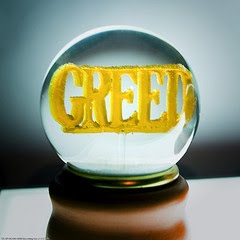
Snowman Visions

Last week, I finished a book called Oryx and Crake, and dystopian science-fiction novel by Margaret Atwood. I bought it at the recommendation of a friend, and I will now pause to insert the necessary statement to make the monitoring powers happy: I am not reviewing this book for gain, nor have I been offered or am I receiving any compensation by an author or publisher for mentioning it here (this, in fact, is not even a review). The cataclysmic future it portrays is easily imagined…I found myself seeing how we could get there from here without significant effort. In fact, it seems a very possible outcome should we simply keep doing what we’re doing.

The book left me thinking a bit of Lewis‘ warning that, just because we can do something, doesn’t mean we should. On a personal level, there are many things that I am physically capable of doing, and, at my worst, emotionally capable of doing, as well. That doesn’t mean that I should. I think a similar theme…a through-line, to use the theatrical term…can be seen internationally as we seek to dominate the world around us, to beat it into submission when it will not go quietly.

I’m not speaking against the huge advantages that the tools of technology provide us…I’m way too much of a geek to do that. I’m thinking more of the gestures we make to bend the natural to a different image, to make it into not even our image, but one that we think will work for the moment. In doing so, we pollute and waste, we clone and experiment, we do things to ourselves under the guise of “medicine” that should never occur. We cut and splice. We wage war and destroy.

I wonder about decreasing life spans at times, about whether or not we look remarkably different from the way we were designed to look. I wonder about so-called “disorders” of attention and behavior and see immediate connections to how we’ve created them. I think of the enormous prevalence of cancer in the area in which I grew up, and I become nervous, not only for myself, but for my family as well, because I’ve seen the havoc brought about by that particular disease, a disease that I think our waste and pollution is largely responsible for creating. I think of my poor eyesight, that I’m nearly blind without my contact lenses, and how that wouldn’t have been the case had it not been for an overabundance of television screen as a child. I think of the various ailments with which we live every day.

I know that there are scientific explanations, and I know the theological answer to this. At the core of the theological answer, however, is pride, and I think that it is pride that drives us to experiment until we do unwitting damage to ourselves. Yet, without that desire, that urge to improve and move forward, that inherent motivation that drives such experimentation, I shutter to think of where we would be. And its so difficult to nail down: we can’t make the blanket statement that inventions for the sake of convenience are all bad. While some are (the frozen dinners that rot our internal organs with their preservative chemicals), others just make sense (like remote controls and online banking). That said, I still wonder what an atmosphere full of the radio waves that drive the lifestyle to which I’ve become so accustomed causes to happen in the long run? For that matter, I wonder about the effects of an apartment filled with radio waves.

In our quest to invent and create and, ultimately, rule, humans are very bold in  how we push ahead. Perhaps a bit more forethought as to the potential ramifications should be considered. Many of the conveniences I think of lead to significant lifestyle changes, and those lifestyle changes lead to fundamental shifts in metaphysical perspectives (such as a lack of perceived value in a human life), and those shifts in perspective lead easily to the sorts of consequences Atwood envisions.

And twice in the last few months, in two excellent works of science fiction, I’ve seen the prediction of these consequences preceded by the casting aside of artistic expression and spirituality.

When I think about how we shouldn’t do everything of which we are capable, I think of the reasons why we should not. The things that we can do are the realm of the hard sciences, the inventions and discoveries that facilitate us accomplishing what we do. The reasons why we should reconsider potential Pandora’s Boxes are the realm of spirituality, and this is most often communicated (and perhaps best communicated) through the arts. To say that a dystopia on the level of Atwood’s is literally around the corner sounds unrealistic and harsh, perhaps. But I see creative expression cast aside and treated as inferior to the sciences daily (have any teachers lost their jobs in your area lately? I bet the math teachers stayed while the art teachers left). I see spiritual expression (at least that of my own Christian faith) mocked and looked upon as only being divisive and never healing. Ironically, I see the negative emphasized over the positive, while the wonder of new invention is always predicted in terms of the positive at the expense of the potential negatives. Perhaps because that is where the money is to be made, or the power to be gained. In any case, I see our own, custom-crafted dystopia brewing.

Just because we can, doesn’t mean we should.

Photo Attribution: See-ming Lee

Assigning Value?

I was so struck by this discussion when I read it this evening that I think it warrants a second post this week. The students, artists, and theologians over at Transpositions opened this discussion on the importance of art in culture, based on the current controversy in the UK over cutting government funds for the arts. The question is, is art essential to society? That is, when things become critical, should the arts be cut before (to use the specific example used in their discussion) healthcare? What should come before art, and what should come after art, when funding is cut?

Unfortunately, we exist in a world that requires these pieces of paper with arbitrarily assigned values to make anything happen. Since at least the Renaissance, artists have frequently functioned by having wealthy patrons fund their work. Or, they do what I and many others do, and have the bittersweet “day job” that pays the rent while pursuing what we love (a poet once said that the only thing worse than having a job is not having a job).

I have an inherent dislike for assigning monetary values to works of art, or, even worse, to an art form in general. I think the value of good art is inherent. Of course, as humans don’t create ex nihilo, artists must have supplies, and thus receive money from somewhere. Having recently experienced funding cuts for the arts in Virginia, I know how critical some public sustenance is to the art community at large. Yet, as much as any artist will insist on the necessity of good art for a healthy culture, I think the conversation on Transpositions asks an important question: is art absolutely critical for the survival of a culture? When the worst happens, and humanity enters “survival mode” (as in times of war), how critical does art become in Maslow’s Hierarchy? Dare we reduce it to make sure people are fed? Dare we not reduce it to make sure people are fed?

I think good art is indispensable to the emotional, spiritual, and psychological health of any society, as well as for influencing the positive movement of a society (L’Engle once said that only writers with something to say are censored). In both the UK and the U.S., there is an entire industry for creative professionals that will be heavily impacted when funding for the projects that employ them is reduced. During the Hollywood writer’s strike of 2007, many freelance support professionals were out of work for an extended period of time. I understand that a similar situation recently occurred in New York City when a CSI series stopped production. Many similar instances could occur when theatres, symphonies, and other venues are unable to maintain their volume of seasonal offerings.

Another question posed in the original post (for my readers of faith) is: what are the ecclesiological implications of this? In the West, I cringe at the idea of the Church influencing the arts until it becomes better educated about them, lest we end up with more Thomas Kincaid. Yet, historically, the Church has held an important role in the arts that it should reclaim.

Head over to Transpositions and read the post. There are many questions posited there that I haven’t even mentioned. Let them know your thoughts. And I’d love to hear them, here, as well.

If It Isn’t Broken…

Shhhh. Be vewy, vewy qwiet. We’re hunting the wabbit of normalcy.


I guess that’s easy for me to say because I would be, by some standards, sort of deviant. After all, I’m riddled with angst, most especially every time I schedule myself to write. I had serious anger outbursts as a freshman while practicing piano (imagine flying sheet music). I have unprofessional moments of expressing intense verbal displeasure with obvious stupidity that  fits in just fine backstage, but tends to not be received all that well in most office environments. Thus, try as I might to meet enough societal expectations to keep my day job, I am emotionally unbalanced, I question authority, I am a proud nonconformist, and, by our culture’s definition of the word, not entirely normal.


Of course, as my wife’s end of the family is fond of pointing out, “normal” is merely a setting on one’s dryer.


Here’s my defense: the very personality characteristics that  brand me as not normal, different, and outside of the status quo, are what make me creative. They are what make me an independent thinker. If an industrialized society has taught us anything, its that a sanitized culture of balance and recognition of the need for treatment of such…dysfunctions…is necessary for a productive society. We tolerate an eccentric few that serve us in the “entertainment industry,” along with the occasional absent-minded professor or scientist, and the rest of us are expected to conform. Dress codes, codes of conduct…resistance is futile. Welcome to the Borg.


I had an immediately harsh knee-jerk reaction to this article when I read it last week. Moscow’s new metro rail station has been named in memory of the novelist Fyodor Dostoevsky. Artwork on display in the station portray scenes of Dostvoesky’s novels, which were frequently dark in their subject matter (the article cites specifically a grisly murder scene from Crime and Punishment). According to the CNN article, mental health experts are questioning whether or not this is dangerous, in essence, to the public health, because it will encourage actions such as suicide. Essentially, psychological experts desire to censor the art in the station in order to encourage good emotional health among the general population, and we are once again thrown backward into the “life imitating art” controversy. 


I’m not even going to get started on the censorship argument against this, nor the point that quality art is critical for a society’s emotional health. I sincerely hope that goes without saying. I want to trace a line of thought that I’ve followed through two science fiction works over the last few weeks. I recently finished reading The Traveler by John Twelve Hawks. Hawks sets his story in a surveillance society only slightly more drastic than our current culture, controlled by a secret brotherhood that demand compliance with expectations of normalcy from citizens, and systematically track down and kill those who cross to other realms and return with divergent perspectives. All in the name of order.


Almost immediately after finishing the book, Karen and I watched Equilibrium this weekend, a 2003 movie in which society has made feeling illegal in the name of preventing war, and thus art and pets are not only illegal, but destroyed on sight in order to prevent humans from viewing it and subsequently feeling emotion (ironically, this law is enforced by violence…thus nothing has been accomplished because what makes us human is sacrificed in the name of humanity). 


Good science fiction, while doing other things, presents a warning as to where we might go and what we might do with our powers of human innovation. I see the potential for us to travel the roads presented in these two pieces, and I see the discipline of psychology contributing progressively more to the problem. Everything outside of an arbitrarily defined societal norm becomes deviant. With this label, artists who express feelings and function in eccentric ways, also are labeled deviant. Professors who are so enamored with academic knowledge as to lose a bit of common sense, scientists who are absorbed in their discoveries at the expense of basic interpersonal functioning, risk being labeled as dysfunctional. Those who are too absorbed in their creativity to be bothered by the people around them provide us with some of the greatest discoveries and explorations of what it means to be human. Yet, we in our narcissism have decided that they are afflicted by a problem that needs to be “cured.” 


So, have we forgotten that all humanity is somehow dysfunctional? Do we lose sight of the joy of coloring outside of the lines that brings disorder to order? Don’t we understand that a certain amount of disorder is necessary to birth new creativity in the human spirit? 


I’m not arguing that all psychological ventures alienate the arts. To the contrary, very good integrations of the two exist. I think, however, that perhaps we’ve become too confident in our rudimentary understanding of the human mind. Creative personalities, passionate academics, and people of faith can all too easily be labeled as psychologically troubled people. In fact, statistically, we all can be labeled as such, as nearly all of us will experience some level of clinical depression at some point in our lives, for example. That will occur whether or not we view subway art in Moscow. 


Absorbing all of mankind into a definition of normalcy is not conducive to a healthy society. If anything, the constraints brought about by this, the expectations of constant self-control,  lead to even more of what psychology labels “antisocial behavior,” to say nothing of stifling a creative impulse or spiritual experience.


Not everything that falls outside of the realm of our perceived normalcy necessitates a cure. In short, not every clock that ticks differently needs to be fixed.  If we truly find individuality to be beautiful and something to be cherished, then perhaps we can stop concerning ourselves with how many negative implications might result from quality works of art in a metro rail station?  Perhaps there is an element of danger to it. There is an element of danger to all art, and to most of life that is worth living (ask any skydiver). We can’t be afraid of danger, or of walking outside the lines of what those around us do.


In fact, without taking these risks, we cannot move forward with what makes us beautifully human at all. 

Photo Attribution: http://www.flickr.com/photos/jennerosity/sets/72157603834072650/

Overlooking

Last week, while visiting my fellow-blogger Katherine in Washington, D.C., we had dinner at the Hard Rock Cafe. We did this because…well, because I have to eat at the Hard Rock Cafe whenever it’s an option. I just have to. Otherwise the universe could implode.

Don’t laugh. It could happen.

After dinner, we stepped out onto the corner of E and 10th Streets, and I heard a familiar song drifting toward us:

I applauded at the end of the song. Passersby were dropping tips into the man’s saxophone case. I think I made eye contact with him briefly (it was difficult to tell because of the hat, but he noticed I was taking video), and we walked back to our hotel.

When we were checking out of our hotel the next day, we passed a housekeeping staff in the hallway. She smiled, and we smiled, and said “hello.” Nothing really more than that, but hopefully enough to have some positive effect on her day.

Driving back to Virginia from D.C. that afternoon, Karen and I pulled over at a chain restaurant for dinner. We were famished. As it was still only late afternoon, the restaurant was far from crowded, and we had our choice of seats. I remember the waitress more than the food: she caught my eye. Not in a lusting sort of way, but just in the way that she made eye contact and smiled and genuinely conversed, if only in an attempt to understand our order, and was a very beautiful woman.  What leaves me a bit disconcerted this evening is that I can’t remember her name.

I can come close: I believe it was Rachel, if I had to guess. I just don’t know for certain. I’m not wondering because I wanted her number of anything juvenile like that…I’m not the unfaithful type. And, realistically, I doubt anyone would think less of me for not remembering the name of a woman who waited my table once in my life at a restaurant to which I’ll likely never return.  But it bothers me. The reason it bothers me is because she was engaging, and bright. She wore what looked like an engagement ring. I was just curious about her life, because I wanted her to be in momentary recollection as a fellow human being, not just a woman who waited my table. She has a life, a story, passions, and dreams. They’re none of my business, and I don’t really want to go so far as to know them specifically, but I want to know that she has them. I don’t ever want to forget that. Nor do I want to forget that about the sax player that gifted me with his music, or any of the other people that I encounter on a daily basis that are looked upon, whether we like to admit it or not, as lesser in station because of their jobs, their educational levels, or (God help us) their ancestry or heritage. So often, we treat them as though they were there to serve us menially…as though that were their identity, instead of their employment.

We left tips for the housekeeping staff at our hotel, as well as for the valet who parked and retrieved the car. I once heard it said that how well you tip is the measure of how good a person you are, but I don’t think that it can be reduced to a monetary value. I think that’s just a trite way by which our materialistic culture chooses to try to quantify mutual respect and engagement. We’re culturally conditioned, at the end of the day, to look over certain people, to glance past their humanity. In fact, we’re culturally conditioned to look beyond everyone’s humanity while driving, it seems. I don’t want to look on a fellow human being as being somehow less because their employment involves waiting on me at a restaurant (I’ve been on the other side of the food counter in my life…it alters your perspective), or cleaning the hotel room I’ve just used, or any number of other jobs. Jobs that are respectable employment, that earn a living, and that any of us might find ourselves doing at any point.

A professor friend once spoke to me of the city where she lived while teaching at a certain institution of higher learning. She said that, in that city of which the school took a huge part, there was a great lack of professional employment, and that it was not at all uncommon to have your table waited by someone with a PhD. In fact, I’ve known professors who worked as baristas during the evening to make ends meet. And, lest we forget, the stereotype of the actor waiting tables during the day while they try to sell the screenplay they’ve written on the side exists for a reason.

Employment is a means to an end. Certainly, being able to do what we love is an ideal situation, but all of us will have at least some period of time in which we are not able to do that. Hopefully, those moments will lead us to respect everyone regardless of their perceived position on the social ladder, and not to look down that ladder as time passes.

And, as for the artist, a saxophone solo on the corner is just as valid any symphony. The payment doesn’t have to be with money.

Not-So Intellectual Propriety

Is it me, or does the ferocity with which the battle to protect intellectual property make the entire situation…well, less than intellectual?

This story broke over the weekend. In essence, someone in a meeting in L.A. heard some commotion, looked out of a window, and saw what was apparently a scene from Transformers 3 being filmed. He shot a quick video with his phone, and uploaded it to YouTube. The motion picture studio complained of copyright violation, and pressured YouTube to subsequently take down the video.

So, by this logic, filming the people filming the movie is now a copyright violation? Explain this to me, please?

Copyright law exists (in Dave language) to prevent unauthorized copies of a work being made. When I copyright a project, that is to prevent someone from making copies and distributing them without my permission, or from claiming it as their own. The second is always the primary motivator for me: I register my work for either copyright protection, or under a Creative Commons license, in order to prevent someone from claiming my work as their own. As recent attempts to lock down every conceivable form of media imaginable in insanely counter-productive ways by groups such as the RIAA, MPAA, and many book publishers has shown us of late, however, this can be taken to such an extreme that lawful users have difficulty legally obtaining copies of the work. 

A slightly grey area exists in the so-called doctrine of fair use, which permits certain uses of copyrighted material without permission, but not for profit, such as in the case of educators using material for instructional examples in their classrooms. When you use someone’s material as support in an argument in an academic paper, for example, you are using it under fair use, citing the source on your bibliography page.

Here’s the issue: I don’t understand how one could claim that the guy filming the filming of this movie scene was attempting to steal part of the plot from the Transformers 3 screenplay (after all, he apparently identified it as exactly that, thus effectively citing the source). In fact, I see nothing here that would indicate that he was even distributing a part of the movie without permission. He was making a brief, obviously amateur video of a movie crew shooting part of a film on a public street. How do you copyright the act of creating part of a creative work in public? That could easily have been a different movie, and the segment he posted to YouTube could well end up on the cutting room floor. By the same logic, if I encountered a famous novelist in a coffee shop writing his next great work, and snapped a quick picture with my phone for Twitter, could I then be sued for copyright violation if a few words on his laptop screen happened to end up in the photo?

Paranoia is a sad thing. We live in an age of YouTube, Flickr, and multiple other ways in which video and photos of average individuals walking through public areas may end up on the Internet. We are filmed at intersections by traffic cameras frequently. We may end up in the background of someone’s vacation photo. If anything, privacy issues may be at stake. Perhaps the film crew could object to their images being uploaded without their consent, but on the grounds of privacy, not copyright. Even on privacy grounds, I doubt this would be a viable claim. The only way to ensure you will not end up on the Internet today is to not leave your home.

I’ve mused here before that the only way to be true to one’s art may be to not make a living creating said art. All too often, corporations are permitted to own the art, or at least it’s production channels, in order for the artist to make any sort of income from their work. When corporations fear that their precious profits may be lost, this sort of over-reaction becomes rampant, making the world a smaller place for everyone. In fact, clips such as these could well result in better box office performance, as some will go to the movie in order to see if the scene they watched on YouTube is in the final product.

So, hold on. I’m about to do something crazy:

There. I’ve filmed myself writing. Now I can sue myself for copyright violation, right? I’ve infringed on my own intellectual property!!

Oh, wait. I suppose that wouldn’t make much sense.

Would it?