Responsive Reading

“But I don’t want to get addicted.”

That was my response to Karen when she announced that she had discovered a new television program to which she wanted me to become addicted with her as she perused the new season offerings of CBS this afternoon. Because I’m not an avid television watcher, I pushed back on the idea, even though I recognize that most of the few programs to which I have developed a loyalty have come to me by Karen’s recommendation. For the most part (Glee notwithstanding), my wife has good taste.

The program that she submitted for my consideration (the second in two days) is called Person of Interest, and it is sort of a re-imagining of Minority Report. The difference is that, in Minority Report, the future crimes were predicted by mutants with pre-cognitive abilities. In Person of Interest, the predicting is accomplished in anonymity by a surveillance algorithm, leaving those with the information to do something about it. The person who invents the program comes into possession of the anonymous data, and hires a former CIA operative to handle the less savory aspects of solving the situation. He doesn’t shy away from violence, and metes out what justice he deems necessary to prevent the innocent from being harmed.

I don’t identify addic…er, I mean, loyal following…to any program after one episode. This one, however, has potential. Watch it and let me know what you think.

What strikes about both this program and Minority Report is the method used to prevent what is recognized as tragic…that is, the loss of human life. Both premises deserve credit for recognizing that human life is immeasurably valuable and must be preserved. However, the error that I see in both is the approach taken to preserving human life: violent justice. In fact, the violent justice that is justified as a means to protect the innocent ultimately necessitates that it must itself take life, and I’m reminded of the adage that my parents used to tell me that “two wrongs don’t make a right.” This smacks of a very Western, very American, method of using justice: that the enforcers of what is right and good do their enforcing by means of overwhelming force. Essentially, “might makes right” begins to be the accepted thought process.

Now, certainly, both Person of Interest and Minority Report are addressing larger themes as well, not the least of which are determinism over free will and the corruption resulting from power. I would guess that the nature of justice is likely far down the list of themes that leap out from these screenplays. I was just left thinking about this specifically today, though, after watching the pilot episode. I’m wondering about the better way to preserve the value of life…how do we do that as a culture? Our justice system emphasizes punishment, not grace. In fact, second chances in Western culture are rare events in any form, and I think we need to focus more on forgiveness and giving more grace as a culture. I also think, though, that a conscious decision must be made to recognize human life…every human life…as something inherently invaluable, and not a commodity that can be taken away at will for some transgression. We view life as so expendable. We view anger and retaliation as acceptable forms of response to a person or group that has done wrong.  The prevalence of “Wild West” violence on our streets, the willingness of our country to leap into war, are indicators of this.

I’m not naive enough to think that we can achieve a utopia of crime-free existence, and violent offenders will always be a sad reality. I just can’t help but think that cultural mores drive more individuals into the mindset of violent offenses than we might see otherwise. I also think that valuing a person for more than what they can produce or contribute would produce less un-addressed frustration that boils over into violence.

I also know that I’m opening a quagmire of debate by saying this. I think, though, that one of the things that these screenplays show us (perhaps inadvertently) is that justice does not have to be a response composed of overwhelming force. I think that there are gentler, and more effective, methods of protecting the innocent, not the least of which is a paradigm shift in which we see the life of the innocent as worth more than the possessions of which one might rob them, or the object of revenge for whatever wrong that they may have done without knowing. Perhaps a recognition that none of us are innocent, and that we would all like some form of second chance, would go a long way here, as well.  Something, ultimately, that is best accomplished with hearts and minds, not fists.

Discovering that is worth being addicted to a new program. These writers are saying something important, and I think that we should listen.

Photo Attribution: Dan4th

To Twist, or not to Twist?

I wasn’t planning on expanding on my last post, but I just found myself inspired.

When I say inspired, I’m talking about my work in progress, which is a science fiction novel. I met my self-imposed deadline, and finished Part I just before the new addition to the family arrived, working under the assumption that I would only have to time to edit for about a month after she was born, if I had time to do that. So far, I’ve squeezed out about an hour to tackle some editing, only to discover just how enormously monumental a task this is going to be.

When I say “rough draft,” I didn’t realize just how rough it is.

Tonight, though, I was finishing playing catch-up on Haven, which I blogged about at the beginning of the week. This season has ended with some excellent plot twists that I just didn’t see coming. I respect the writing a great deal, and I’m very much anticipating next season (we had to wait for season 2 after a cliffhanger, and they’re using the same approach between seasons 2 and 3).

I remember these sorts of plot twists in Heroes, as well…back in its first two seasons when it was still an excellent program. Unfortunately, it didn’t survive the writer’s strike, but the show was known for outstanding and inventive teasers and plot twists that kept you hooked from week to week. In that way, it left me in mind of the comic books to which it paid homage.

And, since those comic books inform my own work in progress, I’m wondering if that specific type of foreshadowing and twisting is even possible outside of a serial. That is, since I’m writing a novel, I wonder if its possible to include that in a novel’s format? Certainly, there are writers of various genres that have reputations for keeping the reader guessing as to what’s really going on. Yet, when I think of the great writers of speculative fiction…the Asimovs and Henleins…I don’t really see these types of plot twists in their work.

Not that I’m thinking that I could even possibly be at the level of those writers. I’m just inspired with these sorts of surprises in story arcs, and I’m left wanting to re-visit the ideas that I formulated for the second half of my work in progress. My concern with this project from the beginning has been that the plot is interesting, but not gripping. I’m inspired to explore the possibility of twisting the plot around a bit. Yet, I don’t want to impose something onto the story that doesn’t belong there. That is, I don’t want to try to make it something its not, but I don’t want to hold it back from reaching its potential, either.

Decisions, decisions. And that, of course, is assuming I have to time to explore any of this any time soon as I’m busy exploring my new role as “daddy.” Here’s to the weekend!

Boo!

Every now and then, I find myself right in the middle of a trend that I always vowed to avoid, and am amazed at myself. “How did that happen?”, I think to myself. Its not always a bad thing…typically pretty innocent, to be honest, and often, in the interest of being genuine about life, I just sort of roll with it.

Actually, “trend” isn’t really the right word choice there, because that brings to mind fashionable clothes and colloquialisms that could invoke images of me speaking vacuously and parading tight jeans down a catwalk (actually, if it brings that to mind, I’m sorry. So, so sorry). I guess “finding myself interested in something popular that didn’t interest me before” might be the better phrase, but it just seemed too wordy.

In any case, I’ve always avoided horror movies and slasher films. They’ve never interested me. And they still don’t. Its just that I typically avoided their close cousin, suspense, as well.  Ironically, I’ve always been heavily drawn to dystopian literature, specifically dystopian science fiction. I like the “this is what’s going to go wrong if we keep going the way we’re going” warnings that these stories present. I like a good action film as well as the next guy, as long as its not blowing things up for the sake of blowing things up. But suspense I’ve typically stayed away from, with only occasional exceptions in the past.

Lately, though, without realizing it, I realize that I’m into suspenseful tales. I first noticed it while watching  Dr. Who. Karen comments on random episodes that she doesn’t want to watch them because they look too scary. When I watch them without her, I realize that there is a suspenseful element to them…the sort of “jump because something just popped out of the closet” suspense. No violence, no bloodshed, just real suspense of the sort you would find in a good children’s tale.

Similarly (because Karen didn’t want to watch an episode), I’ve discovered the same thing about Haven. If you’re not familiar with Haven, its one of the more original concepts that the SyFy network has produced lately, and an unlikely addiction for me. The gorgeous location shots are enough to bring you back for each episode (the story is set in Maine, and filmed in Nova Scotia), and the plot is based on the works of Stephen King in very original ways. I’m not a Stephen King fan, and I’ve only ever seen one of his films that I can recall (and didn’t finish that one). Like I said, its just not my genre. I’ve never read any of King’s work, either. If I had, I would probably thrive on the hidden references that are sprinkled through the show that link back to King’s work and, as I understand it, thrill his fans. Still, Haven isn’t frightening or anything close to the horror genre. Its good science fiction, just dark and spooky enough to pique my interest from week to week.

I’m not sure why I’m drawn involuntarily to suspense and spookiness of late. It hasn’t shown up in my writing, at least not that I’m aware of, but I’ve noticed it popping up more and more in the things I enjoy watching since Karen has pointed this out to me. Its even popped up in recent reading choices. I’m interested to see where this goes in my story interests in the future.

Are you into scary? If so, I want to hear to hear about it…

Photo Attribution: The Intrepid Traveler

The Book of About-Faces

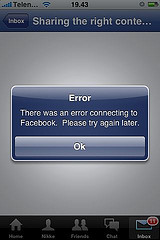
Because I can count on one hand the number of my close friends who don’t use a social network, and because Facebook has been a dominant online presence for me for some time, Facebook’s announcement last week caught my eye.  I’ll say up front that I’ve been disillusioned with Facebook for some time, and each of the “improvements” that they make to their user interface and website design leave me grumbling and trying to figure why they, like Microsoft, never actually improve anything, but merely make it more difficult to get to.  Now, I’ve read several opinions about how positive this latest overhaul of Facebook will be, and I’ve heard at least one colleague say that this is the best thing Facebook has ever done. However, as I’ve come to use Facebook less and less (at least as far as my personal page is concerned, if not so much this blog’s Facebook page), I’m struck by the rationale behind this change.

Karen is much less of a sharer than me. I readily post details on Facebook about myself and us, including “checking in” to particular spots that I frequent.  However, I post less intensely personal information on Twitter. Part of the reason I have chosen to use Facebook for this purpose instead of Twitter is because Facebook is a “walled garden;” that is, I have (at least until recently) had careful control over who sees this information. I know that my Twitter feed is open to the public, so I filter the information I post there more carefully. When we were in the hospital last week delivering our baby, I kept family and friends updated via status updates on Facebook in detail, but gave much less detail on Twitter. This is because I knew exactly who was going to see my Facebook updates, but not my Twitter updates. Part of Facebook’s overhaul, as I understand it, is to make sharing more automatic. I hear this to mean that my online activities will be fed into Facebook without my thought or ongoing permission. There is such a thing as too much sharing. I post a lot of the books I read,  but not all of them. I share several links I find interesting, but not all of them, and certainly not all of them on Facebook. I want to give more awareness to what I share, not less. This seems to place me at odds with Facebook’s new strategy.

And, honestly, that form of sharing wasn’t the reason I set up a Facebook profile to begin with. Real-time sharing has always been Twitter’s strength, whereas a Facebook page, for me, is a static place to be able to communicate with friends and family even though their phone numbers of email addresses may have changed. I began to dislike Facebook when it began trying to copy Twitter…that is, when it tried to become a stream of real-time updates like Twitter was. I’ve always been a fan of a business being good at its specialty, and not trying to spread into multiple specialties. At some point, things become diluted until nothing is done well.

What grabs me more than disagreeing over the approach of Facebook, however, is the culture of sharing that has launched the changes. The mentality of our culture, and apparently of Mark Zuckerburg, seems to be that true happiness is only found when we’re completely transparent with everyone around us. As an introvert, I find the idea of everyone around me knowing everything about me to be remarkably similar to hell. Perhaps this is another way in which our culture rewards extroverts and prizes them as the examples of “good people,” but there is such a thing as too much sharing. I resonate with a comment that I read on Google+ recently to the effect of transparency being a good thing with politicians because we pay them, but opaqueness for the rest of us being an equally good thing. I think we forget that anything we post online has no expectation of privacy, and that its online forever, somewhere. Still, I have no obligation to be transparent to my neighbors. I only share what I choose to share, and I don’t like the idea of someone sharing things that I don’t agree to being shared.

My fellow-blogger, Ami, recently said that she intentionally never posts pictures of her children online, for any reason, and becomes upset when others post photos of them and tag her in them. As my daughter joined the world last week, I thought about this. I shared photos of her with my friends on closed networks, but not here, which I leave open to anyone who wants to read, and not on my Twitter feed, where I do the same. And, I was specific and careful about which photos I shared. When she’s old enough to make the decision of how much of her life she chooses to share, then she can, but I’m not going to rush that for her. Perhaps, after all, she’ll be an introvert like her dad.

My answer to the whole thing? Move away from social networks that don’t protect and respect my privacy. I’m over Facebook. I’ve found myself using Twitter much more fruitfully for some time, but I have to recognize that I use the two networks for different things. Earlier misgivings aside, I’m particularly taken with Google+, where I can meld my pubic and private sharing with a much greater degree of control than Facebook permits. I’m also considering creating a Tumblr page, and would gladly remove myself from the Facebook world altogether and make Google+ (and potentially Tumblr) my primary network(s).

Here’s the issue with that strategy, however, and its one that concerns me: Facebook, as a sort of patriarch of social networks, has achieved a “too big to fail” status. This manifests to me most readily in the fact that I find myself forced to keep using Facebook because that is where most of my friends remain. A social network, after all, is only as effective as how many of your friends, family, and colleagues with whom you can be social. So, for now, I continue to touch base with my Facebook page, but with much less frequency than I have in the past. I’m waiting patiently until more (or even most?) of my friends begin to use Google+, in the hopes of leaving Facebook behind forever.

What are your social network preferences? Are you tired of Facebook’s privacy abuses? Tell me what you think.

Photo Attribution: Nikke Lindqvist

Looking Different

There are these occasional moments in life that are simply and absolutely too surreal to ever just forget. They are the moments that are inscribed onto the parchment of our memories in permanent ink in the instant that they happen. You’ll never lose them, at least not normally, and you know that. Some of them are events that were momentous or tragic, and unexpected…you know, the ones to which you can immediately answer the question, “where were you when (fill in the blank)?” Others are things that you knew were coming, and that you were anticipating, but that you had no clue how they would cause your entire life to go sideways. As much as you sort of knew that you would never be able to wrap your brain around the rest of your life afterward, you just didn’t know to what extent that you wouldn’t be able to do so, or how little, in that instant, you would care that you couldn’t.

When Karen called me at my day job nine months ago as she was leaving her doctor’s office and told me we were expecting, something happened that rarely happens with me. I was speechless. I was, in fact, stupid for several minutes, unable to do basic tasks like talk on the phone with any sort of proficiency. I remember driving home that afternoon, and thinking that life literally looked different to me. As strange as it sounds, the vehicles in traffic around me looked differently, the people around me as well. And here any skills I have as a writer fail me, because I couldn’t describe how they looked different, only that they did.

Last Wednesday, after a long and arduous labor, I was sitting at Karen’s side, able only to see her face among all of the accoutrements of the operating room as a C-section was performed to deliver our little girl.  I’ve jokingly told some friends since that night that, up until then, our daughter had sort of existed only in theory in my mind. That is, all the business and painstaking care of preparing for her arrival had busied our schedules, brought our friends rallying, and taxed our bank account, but, not only have I never had a child before, but neither have I spent any significant time around them in my life.  Not only did I not know what to expect, but I didn’t even a referent for what this could be like, outside of the stories of others.

The cry came out of the blue that night, piercing the room while yet being melodious, and I saw my tiny little girl for the first time. I’ve experienced my share of moments in which I felt the Divine reach into my daily life, and certainly that was one of them. I was exhausted, with no more than three hours of sleep out of the last twenty four, and had honestly become emotionally flattened until that moment. Then, all at once, all of those months spent talking to my Karen’s stomach paid off, because my daughter knew my voice! Due to some complications, I went with our daughter for her physical, and stayed with her for the nearly three hours of recovery until Karen could join us. In that period of time, she came to trust my voice, to calm when she heard my voice, to focus her wide and inquisitive eyes on her daddy, to orient immediately to the sound of my voice. Since then, when no one else can console her, I can. As overwhelmed and maddening and stressful as the last few days have been, as poorly as I have coped with the chaos that has descended on the household despite my best attempts to curtail it, the protective instinct that I have for my daughter is at times overwhelming. I have had, and continue to have, moments in which I’m irrevocably convinced of my own ineptitude, as well as the knowledge that I cannot possibly continue this for another day. Yet, I know her face, I can discern her cries, I let her grasp my  finger in her tiny hand, and I get to know her better daily.

For the rest of my life, I will be getting to know her. She isn’t just a theory anymore.

I don’t think I have to describe a faith metaphor about this…I think you can get there from here. I just know that while I knew my life would never be the same upon returning from the hospital as it had been when I left for it, I didn’t have any way of predicting that it would be this different. And, if I thought that everything looked different on the day I found out, that pales compared to the way things look today in a such an extreme as to be nonsensical.

I have a daughter. I’m a father. I’m not just married now, but I have a family of my own. There’s so much that goes with that, that I can’t even begin to unpack it yet. And I’m not sure that I ever will.

And, somehow, I’m beginning to be okay with that.