Monday night’s dinner conversation revolved around many topics, one of which was customer service. A friend had experienced an issue with a company from which he had purchased some materials for a home improvement project that had turned out to be unsuitable for what he needed. He described a situation in which his call to the customer service department to arrange a suitable refund for his purchase had been escalated by unresponsive staff, until he had to become rude in order to get anything accomplished.
We’ve all had those experiences: when the company involved obviously owed us a refund or a replacement for a defunct item that we’ve purchased, and seems to put up a fight in an effort to keep their money. I remember making a similar phone call to request a replacement for an item that I had purchased that had essentially arrived un-functioning, and Karen telling me in the background that I needed to become more firm.
“Honey, you weren’t angry enough.” she told me after the call.
Now, I don’t even pretend to have any sort of business savvy. Making a decision based upon whether or not I can earn a profit is sort of an alien concept to me. I would think, however, that, for a business, a good reputation and an attempt to avoid a “once bitten, twice shy” response on the part of any customer would be more important than the price of a single retail item. I feel like the issue is one of placing the profit or money in a position of priority over the person in question. The issue isn’t a “customer is always right” mentality, because that’s about doing business. The issue is about recognizing that the person is a human being, and deserves to be treated well. The issue is also about accepting responsibility for the problem potentially being on your end, which is an act of courage.
I’m sort of concerned that both of these look to be notably absent in much of our interactions with each other, both business interactions and interpersonal interactions. The idea that anyone would have to enter a mentality that involved being angry or rude with the person on the other end of the phone disturbs me. Perhaps the entire issue is one of placing someone else’s best interest above your own.
I suppose that’s a bad business choice. I think, though, that its a good life choice.
Just a short list to end the week with. NPR posted this list earlier in the week, which is a listener-generated list of the top 100 science-fiction novels that everyone should read. I’m proud to have several of the books listed here (at least in the top 50) to my reading credit, and, in some cases, I can honestly list some of these books as being among the most influential books I’ve ever read. The Hitchiker’s Guide to the Galaxy and the Foundation series were all books that I read during periods of my youth that were very formative to my writing life, and also to my reading tastes.
There are some books that I’m surprised that aren’t on the list, as well…Henliein’s Friday, for example, which is the book that caused me to fall in love with the genre as I now know it.
In any case, though, there seems to be books here for both the serious science-fiction fan, and the science-fiction novice. Tell me, which ones have you read? And do you find any of your all-time favorties on here?
So, I’m apparently on a “write about super heroes and science fiction” trend.
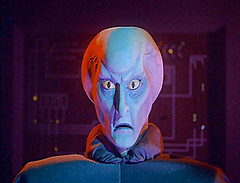
As family keeps arriving to visit the new baby, there are many movies to be watched during baby’s nap times. And, because I have the coolest extended family ever, Dr. Who is, of course, an obvious choice for said movies. Specifically, this week we voted for classic Dr. Who movies with Tom Baker as the Doctor. Of course, such classic films from the 70’s bring about comedic commentary on what a colleague referred to as “cheesy” special effects…in this case, a giant alien grasshopper-looking creature and a metamorphosing man who’s green alien appendage looked suspiciously like colored bubble wrap.
I was reminded of another science fiction program to which I held long term loyalty (and occasionally enjoy re-watching), Farscape. Farscape preceded widespread use of computer generated effects by some time. I have especially fond memories of watching new episodes in my old bachelor apartment in my first days of life-after-college. The series, produced by Jim Henson Productions, featured puppet-style aliens that were quite impressive. Of course, modern make-up had long produced outstanding aliens in series such as Star Trek: The Next Generationor Star Trek: Deep Space Nine. This was because this type of creative make-up and building of puppets was the norm at that time, and those who practiced the art were quite good.
During my theatrical adventures, I’ve worked with some amazing make-up artists. I’ve been aged and made younger. I’ve had a gruesomely realistic rope burn placed on my neck when I played a character who had returned from the dead after being hanged. There’s something really special about the kinesthetic process of building special make-up effects, puppets, and masks. I loved that this art translated so beautifully to the screen, as well as the stage.
And, today, I just don’t see it any more, or at least not as prominently. There are now science-fiction programs featuring completely computer generated characters and backgrounds, in which the actors film almost exclusively in front of a green screen. I admire the ability of the actors to do this. I miss, though, the artistry of the puppets and amazing make-up effects used to create alien races and all manner of wild visuals. I respect the skill of the animators and graphic artists, don’t get me wrong. Tron remains, in my opinion, one of the greatest artistic achievements of our age. Digital artists are of just as amazing a talent as make-up and costume artists, and I find it particularly beautiful when all of these disciplines work together.
I just miss the exclusivity of the puppet-building, make-up brush-wielding, alien creators of science-fiction programming of yesterday. Call it nostalgia. Call it old-school. There was just something about those giant puppet aliens. Don’t you think?
Ever since the hidden teaser for next summer’s Avengers movie at the end of Captain America: The First Avenger, I’ve been anxiously awaiting the full trailer with almost as much anticipation as I would await a movie. This week, I was treated to its unveiling:
Now, I’ve had some debate with others about just how good of a trailer this is, and how good of a film the Avengers may or may not ultimately be. I think its a trailer with promise, of the same promise that I thought Thor’s trailer showed: this movie could go either way, good or bad. Of course, Thor turned out to be amazing, as did Captain America, as did both Iron Man films before them, and I feel confident about the Avengers because it has been set up correctly; that is, it will have what the X-Men never did.
I’ve said before that I’ve been more of a Marvel fan than a DC fan. I’ll admit, though, that the New 52 have tested this resolve, as I’ve become quickly hooked on series that I’ve never collected previously. Still, I think the two universes fill very different story-telling needs, and speak to different cultural trends. DC gives us (especially in the re-boot) the classic hero to fly in and save the day when all else seems lost, a symbol of hope that would otherwise be absent in a dark situation (the plane is plummeting toward the baseball stadium, but Superman shows up and performs the impossible to prevent the unthinkable). Marvel’s characters have always been less of the traditional super-hero, and held more realism that is in touch with our day-to-day existence with all of its angst and fallacies. Even visually, the casual observer will notice the difference: fewer flowing capes in the Marvel universe, and more armor-clad heroes struggling with demons like alcoholism. While DC will always be known to have given us some dark characters (i.e.: the Batman), and the exploration of the fragile anti-heroes by which all others are judged, the trend toward gritty realism tends to lie with Marvel.
While watching the trailer for the Avengers with me, Karen made an interesting observation to this effect: there are more public identities in the Marvel universe. For example, in DC Comics, Superman, Batman, Wonder Woman, the Flash, Green Lantern…all have secret identities. All conceal themselves in some way to prevent the world from discovering that Barbara Gordon, for example, is really Batgirl.
Conversely, the world knows that Tony Stark is Iron Man, and Professor X is in charge of a school for “the gifted,” in which Jean Grey operates under her actual name. Others, like Thor, have no need for a secret identity. The Fantastic Four are all public personas. The world even knows that Bruce Banner is the Hulk.
I think that this again speaks to the ability of Marvel’s characters to connect more deeply to a culture at the time in which it exists. America is more than tired of a lack of transparency in public figures, and the public feels burned by a few too many secrets kept by those that they elected. The general thought process of those in leadership, whether it is leading a country, a business, or a volunteer organization, is that the people below you on the chain of command (or the general public), to quote a famous line from another movie (ironically dealing with similar topics), “can’t handle the truth.” And, while certainly intelligence gathering and secret keeping are necessary in governments in today’s world, there is significantly more kept from public knowledge that could easily function within public knowledge.
DC Comics superheroes frequently fight not only the bad guys, but also the perception of the public that they are “vigilantes.” Often on the run from law enforcement just as they’ve finished saving the city or the world once again, they are faced with suspicion: if you’re the good guy (or girl), why won’t you show us your face? While Marvel certainly has its share of secret identities and those officially held in disdain by the government (such as the X-Men), other heroes…often the ones of which we immediately think when we speak of Marvel Comics, make their identities known to the world. In fact, the Avengers are an organization sanctioned by the government for most of their comic book history.
I think Marvel continues to meet us where we are better than DC, to help us feel more connected to its heroes. DC seems to focus on the heroes far above the rest of us mortals, those who know things we don’t know but act always to save us, to use that knowledge responsibly. One is a more classic image of a hero, the other more modern. I think both are needed, though, and I enjoy reading both for different reasons.
What do you think of when you think of a hero? Which characters speak to you more, and why? I’d love to hear your opinions.
That was my response to Karen when she announced that she had discovered a new television program to which she wanted me to become addicted with her as she perused the new season offerings of CBS this afternoon. Because I’m not an avid television watcher, I pushed back on the idea, even though I recognize that most of the few programs to which I have developed a loyalty have come to me by Karen’s recommendation. For the most part (Glee notwithstanding), my wife has good taste.
The program that she submitted for my consideration (the second in two days) is called Person of Interest, and it is sort of a re-imagining of Minority Report. The difference is that, in Minority Report, the future crimes were predicted by mutants with pre-cognitive abilities. In Person of Interest, the predicting is accomplished in anonymity by a surveillance algorithm, leaving those with the information to do something about it. The person who invents the program comes into possession of the anonymous data, and hires a former CIA operative to handle the less savory aspects of solving the situation. He doesn’t shy away from violence, and metes out what justice he deems necessary to prevent the innocent from being harmed.
I don’t identify addic…er, I mean, loyal following…to any program after one episode. This one, however, has potential. Watch it and let me know what you think.
What strikes about both this program and Minority Report is the method used to prevent what is recognized as tragic…that is, the loss of human life. Both premises deserve credit for recognizing that human life is immeasurably valuable and must be preserved. However, the error that I see in both is the approach taken to preserving human life: violent justice. In fact, the violent justice that is justified as a means to protect the innocent ultimately necessitates that it must itself take life, and I’m reminded of the adage that my parents used to tell me that “two wrongs don’t make a right.” This smacks of a very Western, very American, method of using justice: that the enforcers of what is right and good do their enforcing by means of overwhelming force. Essentially, “might makes right” begins to be the accepted thought process.
Now, certainly, both Person of Interest and Minority Report are addressing larger themes as well, not the least of which are determinism over free will and the corruption resulting from power. I would guess that the nature of justice is likely far down the list of themes that leap out from these screenplays. I was just left thinking about this specifically today, though, after watching the pilot episode. I’m wondering about the better way to preserve the value of life…how do we do that as a culture? Our justice system emphasizes punishment, not grace. In fact, second chances in Western culture are rare events in any form, and I think we need to focus more on forgiveness and giving more grace as a culture. I also think, though, that a conscious decision must be made to recognize human life…every human life…as something inherently invaluable, and not a commodity that can be taken away at will for some transgression. We view life as so expendable. We view anger and retaliation as acceptable forms of response to a person or group that has done wrong. The prevalence of “Wild West” violence on our streets, the willingness of our country to leap into war, are indicators of this.
I’m not naive enough to think that we can achieve a utopia of crime-free existence, and violent offenders will always be a sad reality. I just can’t help but think that cultural mores drive more individuals into the mindset of violent offenses than we might see otherwise. I also think that valuing a person for more than what they can produce or contribute would produce less un-addressed frustration that boils over into violence.
I also know that I’m opening a quagmire of debate by saying this. I think, though, that one of the things that these screenplays show us (perhaps inadvertently) is that justice does not have to be a response composed of overwhelming force. I think that there are gentler, and more effective, methods of protecting the innocent, not the least of which is a paradigm shift in which we see the life of the innocent as worth more than the possessions of which one might rob them, or the object of revenge for whatever wrong that they may have done without knowing. Perhaps a recognition that none of us are innocent, and that we would all like some form of second chance, would go a long way here, as well. Something, ultimately, that is best accomplished with hearts and minds, not fists.
Discovering that is worth being addicted to a new program. These writers are saying something important, and I think that we should listen.