The Nature of a Hero Part III

DC Entertainment is doing something very interesting. I mean, besides the New 52. Take a look:

Besides the fact that this is good charity work, and the fact that it is an excellent quality video that sort of gives me chills, there’s something really fascinating in the way DC is packaging this initiative rhetorically.

First off, we’re drawn in by the images of the Justice League characters, ones that are recognizable to even those not engaged in comic books (and leaving me very much in mind of the recent animated series intro.). The video is immediately evocative as a “person on the street” video can be: we see honesty, people admitting that they’ve never been needed, but that they have been needy. People self-absorbed, answering their phones. The video is poignant: the school girl remembering when she didn’t stand up for someone in her class being bullied is a time when she was needed, but didn’t react out of fear. This is something to which all of us can relate.

Then, the video moves into the ideal that we hope for ourselves: those who “didn’t think,” and “just went.” These are the heroes, those who reacted despite their fears, and who were a positive influence in a situation. I love the story of the man, taken out of context enough that the bulk of the events remain a mystery, re-telling how he went down on the ground beside someone in order to be with her, to help her get up again.

Then, of course, the video makes its pitch, calling us to action, calling us all to be heroes, and re-connecting us with the images of the iconic heroes that inspire us. The video confronts us with a situation, and gives us another chance to react without thinking, to put fear or misgivings aside, and to be a hero to someone. Even if from a distance. Even if our actions are never known. We’re given an opportunity to reach the ideal.

What’s amazing about the rhetoric of this project is that it is using the secret desire that we all have for a hero to swoop in during our time of greatest need and save us when we cannot save ourselves, and it is leading us to recognize another desire that we all hold: the desire to be the hero. I remember dreaming heroic dreams of coming to the rescue of the girl in distress when I was in elementary school. Heroes have always dominated my imagination, my stories. I’m fascinated by those who place themselves in “real-life”  hero positions, such as first responders. I’ve made professional choices that have placed me in a role to be helpful to others on several occasions.

What this video leads us to conclude is that heroism is relative. That is to say, we all have the ability to be a hero at some point, to someone, in some capacity. All of us can be the larger-than-life savior, landing (metaphorically) in the midst of evil’s apparent triumph, and saving the day. Because the evil that is about to triumph over the person next to us may be small to us, depending upon our gifts and resources. What they cannot defeat on their own, we can, and vice versa.

This video is powerful because it so effectively taps into another aspect of the nature of a hero: the fact that we all have the desire to be the hero. Sometimes this is for selfish motivations, often it is over-ridden by fear, or doubt. For some, it is a driving force, and for some it is merely a whisper of conscience. But it is there, and, I daresay, it is universal to the human experience.

Perhaps that’s why the idea of a hero resonates so much with all of us.
School is in Session

I was nearly finished with grad school before I took my first online course. I had never pursued it before that point partly because of limitations on the school’s part, and partly because the situation had never demanded it that seriously. Once Karen and I were married, however, I still had a semester to finish, and a brand new set of demands on my time management. Fortunately, online courses had become available, and I maximized the opportunity, to discover that I had fallen in love with the format.

Ideally, I like residential courses with a lot of the workload online. However, online classes are certainly the future of education in many disciplines, and I’m fascinated to see things like public speaking now being taught from a distance.

A couple of years ago, I was exploring iTunes U at it’s initial launch. I downloaded a literature class from Yale. I found it outstanding that I could watch a Yale professor lecture on one of my favorite novels, that I was getting the actual content of the course at no charge. Of course, no charge meant no credit, but a thorough education doesn’t necessarily equal heavy credentials. Knowledge is a beautiful thing, whether or not you acquire letters after your name to show for it.

I was only sort-of surprised that someone is finally attempting to bridge that gap, as well, however. MIT is now offering course credit for certain classes taken through an online platform at what many suspect will be a substantially less expensive rate than attending the prestigious school residentially would cost, building on the iTunes U model. This led to some conversation about what the future of education, and really everything else, will look like.

Personally, iTunes U is a gem of which I have yet to make full use. I have a lecture on technological developments in treating autism, and on the philosophy of film waiting for me, though, both from MIT. While researching my novel, I recently watched a lecture on quantum mechanics from Oxford. These are actual lectures from these schools. Typically, an entire course is offered. The knowledge gained is just as real as if you were in the classroom (minus, of course, what you learn by producing graded research assignments and so forth). I love that it’s out there for free.

I think there’s far too little of this. I’m concerned that academia is accessible only to a few. I see this manifest in different forms. While researching a proposal a few months ago, I found myself running up against a paywall. Should I want access to important academic research in the field I was exploring, I had to pay for a copy of an academic journal. Some research I couldn’t access at all because I wasn’t a current grad student. I’m bothered by this. While I recognize that the professors who conduct this research and write these articles for peer review must be financially compensated for their livelihood, at the end of the day, their research is being conducted for the greater good. Thus, I think the general public should have access to these articles.

I also see disciplines in the humanities, specifically the fine arts, being elitist and pretentious, producing art that only appeals to an ivory tower inner-circle of other authors and artists, to the exclusion of those who travel a different social sphere and come from different life experiences.

I think both are wrong. This wonderful knowledge, art, and research is so essential for the continued development of our culture, of our society. As such, it cannot be reserved for the privileged few, but must be accessible to all who wish to explore it. Now, I’m no economist. I have no idea how sustainable something like MIT’s new venture is from the perspective of supporting its professors so that they can do this sort of critical research. I also have no hesitation in agreeing that, if you want the credentials, then you need to do the work in the accepted manner.

All that said, however, I’m excited to see things like iTunes U begin to manifest. I’m excited to see this sort of culture and knowledge become available to our society at large, bridging an economic gap that has prevented many from exploring these sorts of ideas and fields. I hope more of this is to come, and that academic institutions leave behind hopes of profit in the interest of sharing their knowledge with the public.

I think the more art, the more philosophy and theology, the more scientific theory, becomes available for everyone who is interested, the better…dare I say, the more enlightened…we will be together. And I think that only good results can arise from that.

Save the Date

I took my daughter on a date exactly one week ago this Thursday.

It wasn’t a big, noble, pre-planned thing. It’s just that my wife was teaching her night class, and I needed a  burger for dinner. So, I took our daughter with me. I was an instant hit with the waitress, a situation helped, of course, by the fact that she was greeted by one of my daughter’s famous grins that has won over every person ever to see one.

I talked to our daughter that evening. I described my burger, and all the goings on of the restaurant. Of course, she didn’t understand these things, but the point is that she cooed and gurgled in response, and we had a conversation.

Somewhere over the course of Valentine’s Day a couple of weeks ago, I overheard two teenage girls having a conversation…you know, one of those sound-bytes you hear in passing. One was telling the other that she had gone to breakfast with her father that morning, because that was his tradition with her each year. I suddenly find this to be an amazing idea. One of the wisest words of wisdom given to me by family when Karen and I were expecting our daughter was that, if I make spending time with our daughter a priority now, that it will be natural later…that it won’t be forced.

A few months ago, I was waiting in line at a different restaurant. In line in front of me was a gentleman I would place in his early 50’s, still dressed as though he had come from the office, and a girl I would place around 15, that I assume was his daughter. She had that “I have to look dis-interested because I have to be too cool to be out with my dad” look on her face, but it had difficulty balancing out with the rest of her non-verbal cues, which read, “I’m spending time with my dad!

My daughter is at the age where she reaches out for me when she wants me to pick her up. It’s difficult for me to not drop whatever I’m doing, literally, and pull her close. She gets so excited when she sees me first thing in the evening, grinning from ear-to-ear and waiting for her daddy to pick her up.

I think I’m going to steal that Valentine’s Day breakfast idea as our own little family tradition, just as soon as she’s old enough. Because I want my daughter to always be thrilled about spending time with her dad. I want that because I am suddenly overwhelmed with how important it is that she know that she can talk to me about anything, that I am always there to support her.

After all, she needs to know how a true gentleman will treat her, and Karen always says that one of the things that won her over about me was that I opened doors for her on our first date.

So, I took my daughter on a date last week. She’ll never remember the specifics, but I hope she’ll remember the foundation of trust that it’s inspiring. Because it certainly won’t be the last time that I take my daughter on a date.

And I’m going to love every one of them.

An Unlikely Appeal

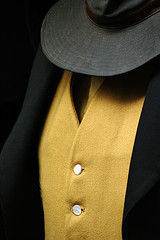
What do you think of when you think of the 1920’s and 1930’s in America? I think of what a lot of us would probably consider to be the marks of the essence of the era: classy dress, big band music, swinging jazz, and gangsters with tommy guns in violin cases. The image of the gangster with the wide-brimmed hat, in fact, continues to be the stereotypical image of the gangster today, pervasive in games like Mafia Wars, and influencing comic book villains. There’s something about the action of speak-easies and federal law enforcement trying to capture villains who have committed atrocities such as the St. Valentine’s Day Massacre that appeals to our storytelling.

Similarly, I remember my father’s fascination with Westerns. I grew up with episodes of Gunsmoke periodically looping in the background. The U.S. Marshal staring down the villain who was doing evil in his town, and ultimately winning in the street because he was the faster draw: That was my father’s idea of a good adventure.

Still today, I’m attracted to a certain amount of action in my escapist entertainment. For me, it’s espionage and spy stories, complete with their fair share of blowing up secret bases and foiling plans to take over the world. Or, just a good dose of come-uppance to the ethically depraved, as delivered ala Jason Bourne.

Yet, when I designed the set for a 1930’s noir style murder mystery show in college, the focus wasn’t on violence, but art deco and glamorous costumes. The entire show had no tommy guns or gangsters to be found, yet was as quintessential of the time period as any other production. Similarly, a tour of the International Spy Museum will tell you that the lives of spies are frequently quite without action, contrary to the assassinations and car chases portrayed in film. And, while the Wild West was wild, it was more so the wildness of the survival struggle between man and the elements, rather that pistols in the street at sunset.

My point is that, for some reason, we find the introduction of violence onto these stories and time periods to be addictive, even glamorous. Lives of daring adventure, in which one’s life might end at any turn, draws viewers and readers into the tale, although they are poor representations of historical accuracy. Which leads me to wonder: why is this sort of violence attractive to us?

In fact, any time I’m confronted with violence in storytelling that draws me into the story, I’m a bit amazed. I say that because, philosophically and theologically, I’m a pacifist. That is, I don’t think violence is ever a good answer to a problem. That being the case, why does it draw me into the movie theatre the same as any of my friends? I’d like to think that I’m not susceptible to this, but I obviously am.

Of course, my diet isn’t a steady intake of action films or James Bond novels. And, there is a point where too much is too much. I wonder if this attraction exists in Eastern cultures as much as it does in the West, or even if it is as pervasive in the rest of the West as it is in the U.S.?

Perhaps we’re all wanting the lifestyles of adventure that break us out of our day-to-day routines? Perhaps we all wish we were a bit more than we are. more heroic? In fact, maybe this plays into the nature of a hero somehow. I’d love to hear your thoughts.

Photo Attribution: fabbio