A Review of “The Dark Knight Rises”

Here’s the thing: I’m a purist when it comes to my superheroes. It’s one thing to radically evolve a hero that originated in a film franchise…I sort of figure that anything’s fair game, there. When you’re adapting a hero from a literary history to the screen, however (yes, I count comic books as literature), then I think that remaining largely true to at least the essence of the book, as well as to most of its specifics, is paramount. In other words, I consider the books to be canonical.

So, when a director can take some liberties with a general story arc, weaving it in such a manner from beginning to end that it remains completely true to the original character while viewing him through the lens of a daringly original story arc over the course of three films, in such a way that I’m perfectly willing to accept the trilogy of films as canonical in it’s own right…that’s quite an accomplishment.

And that is something that Christopher Nolan has done in all three of his films, The Dark Knight Rises being no exception. And, by the way, I’m giving some spoilers here.

This third film in the franchise continues Nolan’s exploration of a hero that, let’s face it, isn’t psychologically healthy. Throughout his comic book history, the Batman has walked the thin line between hero and anti-hero. While ultimately choosing the self-sacrificial path of the hero, he uses methods that are questionable and that flirt with vigilantism. Yet, he is a character of rigid ethics, and has set lines across which he will not step…although he occasionally comes pretty close. This is the second consecutive film in which he has encountered a villain that brings him to that edge, and we hear this overtly in this film (when Batman returns Bane’s line, “then you’ll have my permission to die”). Batman isn’t willing to kill his opponent, but isn’t taking the extra effort to prevent his demise, like we saw him do with the Joker.

For anyone who followed the Knightfall story arc from circa 1993, the scene in which Bane “breaks” Batman is nearly picture-perfect from the comic book frame. This event follows a series of poor choices, as Bruce Wayne adopts the Batman persona again after several years of  being a recluse (following his taking the blame for Harvey Dent’s death), and after ignoring the advice of Alfred, who encourages him that the city needs Bruce Wayne’s knowledge and resources, not Batman’s vigilantism.

If one were to attempt to pinpoint a theme for this film, I would say that it is lies, and that, however noble the intention in which they are told, they always return with a destructive force.  Batman’s and Commissioner Gordon’s lies about Harvey Dent come back in a destructive way to the entire city when Bane forces them into the light. Alfred’s lie about Rachel’s choosing Bruce tears he and Bruce apart (with a poignant and beautifully-acted scene in which Alfred recounts his love for Bruce since he first heard his cries “echo off these walls”). In fact, one could say that relying on a lie to protect one’s loved ones is not the choice consistent with the nature of a hero. Bruce’s answer, at least initially, is to continue his self-destructive path, a path of true heroism driven by the questionable motive of welcoming his end, in a way that proves a Pyrrhic victory for the city of Gotham in the end.

The acting throughout this film is incredible. I can’t actually recall a single performance that was less than excellent. Nolan has done a beautiful job rendering one of Batman’s most evil and imposing villains (Bane identifies himself as “the devil,” and as a “necessary evil”), arguably his most threatening arch-nemesis after the Joker. I wondered at Anne Hathaway being cast as Catwoman, but this is the first time I’ve seen Catwoman as her spunky self appear on the screen, both visually as well as deeply as a character. Catwoman is Batman’s mirror image, after all…a villain who walks the thin line of being a hero. This film does Catwoman justice, just as it does every other single major character that appears, with the possible exception of John Blake…and I’ll simply refer that to the aforementioned liberties taken with the mythology and let you decide on that.

As expected, the action sequences are breathtakingly real and well-paced, never overwhelming but completely absorbing. And, of course, Batman gets a new vehicle for this film because…well, because that’s just the way is has to be…and the film’s designers continue their realistic, paramilitary design work that sold me immediately from the first movie forward.

Ultimately, this movie about the Batman as a symbol, and the recurring through-line is that Batman as a symbol is much larger than Bruce Wayne, and that it must be for the good of the city which is what Bruce Wayne always places above his own good. Thus, anyone can be Batman, because it is Batman in which the city needs to believe. This concept is illumined by multiple characters throughout the movie, and, if you haven’t seen it yet, we’ll just say that it’s a great lead-in for another film (*cough* Nightwing *cough*).

This film is a thorough and psychologically intriguing view on Batman that pleases both long-time fans and those who haven’t been interested yet. At nearly three hours, it’s long, but I didn’t want it to end when those three hours were over. Even if you’re just interested in a summer blockbuster, this is worth your while…and I bet you love the character of the Batman as much as the rest of us do when it’s over.


Caffeinated Irony

Sometimes, the irony of things absolutely amazes me.

You see, as curmudgeonly as I can sometimes be, I really am optimistic in many ways. I tend to think, for example, that when someone says that they’re going to do something because they’re motivated by a cause, that they will actually do so. So, I’m caught somewhere between genuine surprise and an “I should have known” attitude when I discover otherwise.

I’m very aware of the environment. Not in a tree-hugging, hippie sort of way, but we’re conscious about watching our energy consumption, recycling, and minimizing the packaging we use. We try to reduce fuel usage. You know, that sort of thing. I don’t see the environment as a political issue at all, I see it as common sense. So, I’ve been quite shocked by how politicized it has become, as well as how little anyone seems to care about it in the Southeast.

I’ve reduced the process of feeding my coffee addiction to throwing away almost nothing afterward. Part of that process is that I use the re-usable personal cups that Starbucks sells…you take it, you get a 10-cent discount on your drink, you wash it later and re-use. It’s not so much about the discount for me, I just like that I’m not throwing something away afterward. That’s really important to me, and, I think, for all of us.

So, one day earlier this week, I run by Starbucks for lunch. I give my drink order, and hand them my cup. Business was a bit slow that day, I guess, because there weren’t many customers ahead of me. So, I watched the barista make my drink. I watched her use and throw away two plastic cups that were the same size as my personal cup to measure my drink before mixing it and placing it in my cup.

Which essentially means that there was no point at all in my even taking in my own cup.

This doesn’t happen across the board, mind you. I don’t see this happen every time, or even most times, that I go to Starbucks. And, Starbucks is one of the few big businesses that I like and that I think makes a substantial effort to be environmentally friendly. Maybe that’s why I was surprised at how succinctly this barista defeated the point.

Insert sigh here. I hope your weekend is…not that ironic.

The Nature of a Hero, Part V

This hero thing just won’t let me go, it seems. What’s more, it keeps popping up in unexpected places, and forcing me to add to my list. Recently, Karen was doing her periodic exploration of new shows to watch and ended up with a program called Eli Stone. The show really didn’t interest me that much, although the premise is, I admit, catchy: an attorney develops a brain aneurysm like what his father had experienced before him, which gifts him with a form of precognition. He realizes that he must use his gift for good, and begins turning from the type of attorney he was in order to help others around him.

Where this becomes interesting is season 2, episode 8, in part of a story arc where Eli chooses to utilize his ability, against the advice of his mentor, to see his own future. He does so because he wants to know what will happen to him, but he deceives himself by saying that he wants to protect his brother. The consequences prove to be dire. At the conclusion of this story arc, Eli says something interesting. He says that the gift he has received (his precognition) is not his own, but belongs to the people around him. That is, the gift is entrusted to him to exercise, but he has recognized that he cannot exercise it for his own good, but must rather place the good of others above himself.

This is a program that is layered with really interesting theological content, and I think that Eli is a hero. The episode I mention here presents what I think is another element of the nature of a hero: the acceptance of the fact that the gifts and abilities of the hero are not given to that person for his/her own use, but for the good of those around him. This is why heroes become self-sacrificial; because they see that, not only are their abilities not for their own good, but that using them for the good of others can easily lead to the risk of the hero’s own life, a risk that the hero accepts. This is why the hero is the hero. The villain and even the antihero make different choices, utilizing their abilities for more selfish purposes.

What’s great about the fact that I found this element in a character such as Eli Stone is that he is an everyman character, and that he does not wear the guise of a hero at all overtly. This proves that those displaying the nature of a hero must not be costumed adventurers, but that all of us can choose to heroically deal with the evils around us. This is what makes the mythology…and the theology…of heroism so important, is because it is so inspirational.

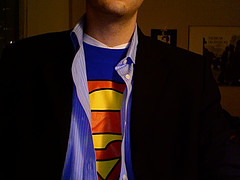
Photo Attribution: Thomas R. Stegelmann under Creative Commons 

A Review of “Alphas,” Season 1

Super-hero science fiction isn’t as common on television as the big screen, and I’m not sure why. The genre lends itself to serial writing…after all, that’s what comic books are: serial story arcs. I haven’t seen a good super-hero story on television, though, since Heroes, a program that began near perfection but didn’t survive the writer’s strike.  So, when I saw the first trailer for Alphas, I was excited, because I was hoping for a positive and deep re-visiting of the genre for the small screen.

And, overall, the Alphas kept me watching (I borrowed a play from Karen’s book, and binged on an entire season in a couple of days). The story centers around the discovery of individuals all over the world developing super-human abilities, and how the world’s governments deal with this phenomenon. The super-humans, called Alphas, are feared and hated by the general public, and factions from both sides are convinced that normal humans and Alphas can never co-exist and that war between the two is inevitable, while others remain passionate about co-existence between the two. This latter position is led by Dr. Rosen, who has formed a secret team of Alphas who use their abilities to search out and help new Alphas who are discovering their abilities and are uncertain in what to do with them.

Sound familiar? It should. Stan Lee pioneered this concept a long time ago with a fictional team that you may have heard of called the X-Men. I was struck within the first episode that Alphas is essentially a re-imagining of the X-Men mythology with some notable changes. Dr. Rosen is a Professor X character, but is not an Alpha himself (although his daughter, we discover, is). The team comes complete with a Jean Grey equivalent, as well, in the character of Rachel. The notable twist on the concept in the Alphas is that this team is not a team of outlaws or vigilantes, but rather an official (if secret) investigative arm of the U.S. government. The team learns to live together in their diversity (again, this should sound familiar) as they learn to became secret, super-powered law enforcement agents.

That major twist is just enough to keep the viewer returning to the Alphas, because they use it to raise and explore very interesting issues. Evil Alphas, for example, are whisked off by the government to a secret hospital where they are warehoused and treated as less than human in order to protect society. Dr. Rosen wrestles daily with the moral and ethical implications of this. How much can our government be trusted to protect us? Who watches the watchmen? These are all the sorts of questions explored by the Alphas.

The explorations, though, don’t go nearly as deep as one would like in any given episode, and I would expect a better treatment of them, as thorough as I would expect in a comic book. The pacing feels strange at times, and occasional breaks in continuity between episodes (a character has a heart attack at the end of one episode and is up and running at the beginning of the next) make a suspension of disbelief challenging at times. The character ideas are more realistic than the X-Men, but the writing feels clumsy and awkward at times.

That said, this was the first season, and many programs don’t come into their own until the second. The cliffhanger certainly kept me anticipating season 2, which I suppose is a good marker for success. If you’re a fan of the super-hero genre, Alphas is a worthwhile program to explore. Don’t compare it to Heroes, because anything set up against the first season of Heroes will fall short. Accept it as what it is, and I think you’ll appreciate it. Not the best I’ve seen in the genre, but certainly a show that holds its own.