So-Called “Faithless” Literature, and a Gospel According to Martha Jones

There’s been some debate lately about whether or not faith still thrives in fiction. That is, there is some speculation that the existential questions traditionally allocated to the realm of faith, such as those of purpose and ethics, and which drove literature in both veiled and not-so-veiled ways for some time, is now addressed or ignored in a purely secular art form.

Paul Elie recently considered in the New York Times whether or not fiction has lost its faith. Gregory Wolfe, editor of Image Journal, responded in the Wall Street Journal, insisting that it has not. Me? I’m strongly in Wolfe’s camp, and not only in literature, but in the arts in general.

I was struck by how strongly different genres of different mediums explore concepts of religious faith when I was around for a random re-watch of an old episode of Dr. Who. The episodes in question, which earned a full re-viewing by me later (what did we do before Netflix?), were the final two episodes of season 3 of the new series, in which the Doctor (then partnered with Martha Jones), finds himself in a desperate struggle to defeat the only other surviving Time Lord, the Master, as he has taken over the Earth and reduced the Doctor to a helpless invalid.

During a year of the Master’s reign of terror (which passes between the two episodes), Martha Jones escapes and wanders the entire planet earth. There, she essentially preaches to the population (nearly all of whom have been enslaved by the Master, and frequently tortured and killed), telling them of the heroic Doctor who is their only hope against the Master…the Doctor who has saved their lives over and again without their even knowing it, and who is the one person capable of defeating the Master’s evil.

The Master fears Martha enough to go after her personally…he arrives on the street outside where she is taking refuge, as one of the helpless slaves states words to the effect of “he never walks among us.” The Master belittles Martha’s faith and hope as being unable to stand against his weapons. He mocks Martha’s efforts just before he is to publicly execute her, as he learns that her plan was to have everyone on the earth, at the same critical moment, think of this mythical figure whom they had never met known as the Doctor.

Because, in his year of captivity, the Doctor has been able to telepathically connect himself with the same mental network that the Master used to persuade the people of earth to place him in his dictatorship. Thus, the Doctor receives massive power from this psionic energy being funneled into him. Essentially, the Doctor’s power comes through the prayer of the believers from Martha’s “gospel,” and he uses his power unexpectedly to, in the moment at which he has the Master defeated, utter the words which he has tried to say yet which the Master has avoided throughout the episodes: “I forgive you.” The Doctor, displaying the nature of a hero, sees the Master has someone worth saving, despite his evil deeds.

And, in the end, the Master’s refusal to be with the forgiving Doctor results in his final demise.

Season 3 of Doctor Who ended with the Doctor written overtly as a Christological metaphor. Difficult for me swallow, then, that art has lost its faith. Every medium and genre is scattered with artists who explore questions of faith and belief from various perspectives, and these two episodes of a science-fiction program are but one example to stand alongside many others.

Perhaps the issue is any delineation at all between “sacred” and “secular,” our insistence on placing artistic expression in one camp or another. I don’t believe that there is any such separation, and I am immediately suspect of any genre distinction that attempts to enforce it.

Faith is not gone from the arts. It is as powerfully stated as ever, if, as Wolfe points out, stated in a different manner, a manner consistent with our cultural evolution. That’s because the existential questions that haunted humanity a hundred years ago haunt us still, and require our attention no less than they did then. That is an integral part of the human condition, and it is the questions of that condition that the arts continue to explore.

Photo Attribution: ewen and donabel under Creative Commons

Ten Minutes? That’s Crazy Talk!

I tweet a lot.

Granted, I was a late-comer to Twitter, but I fell in love with it immediately. It’s simple. It’s not cluttered, it’s real-time, and it doesn’t try to be what it isn’t (which, incidentally, are all the same reasons why I hate Facebook). I think that I love Tumblr for the same reason…it’s not a maze to navigate, it’s just a simple, inspiring stream of creative synergy.

Every morning, though, I log into Google Reader and peruse the many blogs that I follow. I read the posts, and I comment as often as time permits, although I concede that I don’t comment nearly as often as I should. If I follow your blog, then I’m a loyal reader, and I’m grateful in turn to all of the loyal readers that follow me here.

I wonder at times, though, if I’m becoming outdated in my blog habits. What I mean by that is that I what I write here is more of a traditional blog…it’s not bite-sized, it takes a few moments to read. Most of the blogs that I follow are the same. Twitter, a so-called microblog, or even Tumblr, aren’t that way…they’re more easily followed in a few spare moments here and there, while the types of blogs that are plugged into my RSS feed are the types that require 5-10 minutes each to read. That doesn’t make either better or worse, they’re just different sorts of thoughts, and I read and contribute to all three.

Still, I imagine that some of you read that last paragraph and thought something to the effect of, “Ten minutes! That’s crazy talk!” And, perhaps, in a progressively mobile world, it is.

I sometimes think of an aunt and uncle who still take the local paper where they live, and I’ve commented to them several times that the newspaper is less than one generation from extinction in its print form. Still, they read it daily, and dutifully place it in recycling afterward. I wonder if, in my blog reading habits, I’m a bit like that…insisting on continuing with something that is close to extinction (ironically, I’ve written for a few newspapers in the past).

I’ve gotten involved in some discussion here before about why I think blogging is so important, why it fills a niche, why it contributes such value to the public exchange of ideas. Yet, just this week I read another consideration of how blogging could be dying as a medium, or at least evolving into something different, just as Twitter moves to condense video lengths as they have text lengths in the interest of driving further creativity.

I really hope that this wonderful medium of blogging as it has evolved continues to walk alongside microblogs, and isn’t replaced by them. There’s something great that each can do that the other can’t, and if we let either of them go, I think that we would be losing something of great value. I would really be missing something if I was unable to consider the thoughts of those I follow, both their quick, rapid-fire thoughts as well as their longer, more considered thoughts. Both are important.

It’s good, in any case, to pause and take some time with things, and I think that’s something that traditional blogs force us to do when we read them, just as a book does, but on a smaller scale.

And slowing down is always, always a good thing in an environment that is constantly speeding up.

Ten minutes really shouldn’t sound so crazy.

Factual Misperceptions

I’m not going to say what the news article in question was, because doing so would ignite some sort of political discussion in my comment chain, and I don’t do politics here. The offending thing, I’ll simply say, was provocative in it’s writing…not only the headline, but also the abstract. With very little storytelling imagination, I could picture how the actual interviews and press releases involved in composing the story were woven together in a manner that was completely untrue to the reality of the situation in order to get more shock value out of the copy. And, of course, the comments on the story exploded in vitriol.

So, this isn’t a post about politics, its a (brief and ranting) post about journalism. It’s been quite a few years since I’ve done any formal journalism, but the basic tenants haven’t changed. I long for a differentiation in our media between the specifics of “news” and “opinion.” Opinion pages are for the types of things that most of us read and write in blogs. The news is the facts, and “just the facts,” leaving us to make up our minds on the situation for ourselves after being well-informed.

Or, at least, that’s what news should be.

Instead, its a difficult arena to navigate. There are more obvious offenders than others…media outlets that at best slant the facts (by doing reporting that isn’t well-rounded) toward their political preference, or, at worst, completely fictionalize accounts and re-interpret history in order to achieve ratings.

Media outlets, though, shouldn’t have political preferences, at least not that influence their stories. Philosophically, relativism really doesn’t enter the realm of conveying empirical facts. A sequence of events either happened or they didn’t, and careful examination will reveal the manner in which they happened.

Part of the issue is the desire to beat other media outlets to the story, to be the first to report something…which leads to errors in reporting facts that cause undue problems and emotional ramifications. And, while I’ll concede that this might be a bit of a political statement, that’s why I think that for-profit journalism is not a good thing. Ratings and clicks are money, and pursuing more money while attempting to be true to the story leads to a conflict of interest.

The result of slanting the news…which I’m defining here as reporting opinion as fact…is that large numbers of people are swayed to support causes or platforms that they would likely not support were they simply receiving facts to analyze for themselves. And, don’t get me wrong, I’m not removing individual responsibility from the equation. America is certainly a nation losing its ability for critical thought.

Even the most critical of thought, though, can be swayed with a good performance. I’ve directed a lot of plays. There’s a certain power that a theatrical performance holds over an audience once that audience experiences the “willful suspension of disbelief” that is critical to appreciating the story. When journalism takes the role of a performance, it wields a power for which it is not worthy. Statements of social ills are the realm of the performer or the opinion writer. Statements of fact are the realm of the journalist.

I really wish that all sides would get those facts straight.

Dedicated to the Sofa I Left Behind

A couple of years ago, I received a package that we had ordered. I always separate out recyclables from packing supplies, and make certain that things like cardboard boxes and random papers avoid the trash bin. That particular package had arrived in a cardboard box with a web address printed on it that allowed you to track a re-used cardboard box. The idea was that you would be able to see all of the extended life it received through re-use, and thus how many new boxes did not need to be made. A fun concept, I thought.

Sometimes, I wish that I could watch items that are important to our lives as they progress through their existence. There are things, for example, that weave in and out of our lists of possessions that manage to carve out nostalgic slices of our memories, but that we don’t hold on to when we downsize for whatever reason.

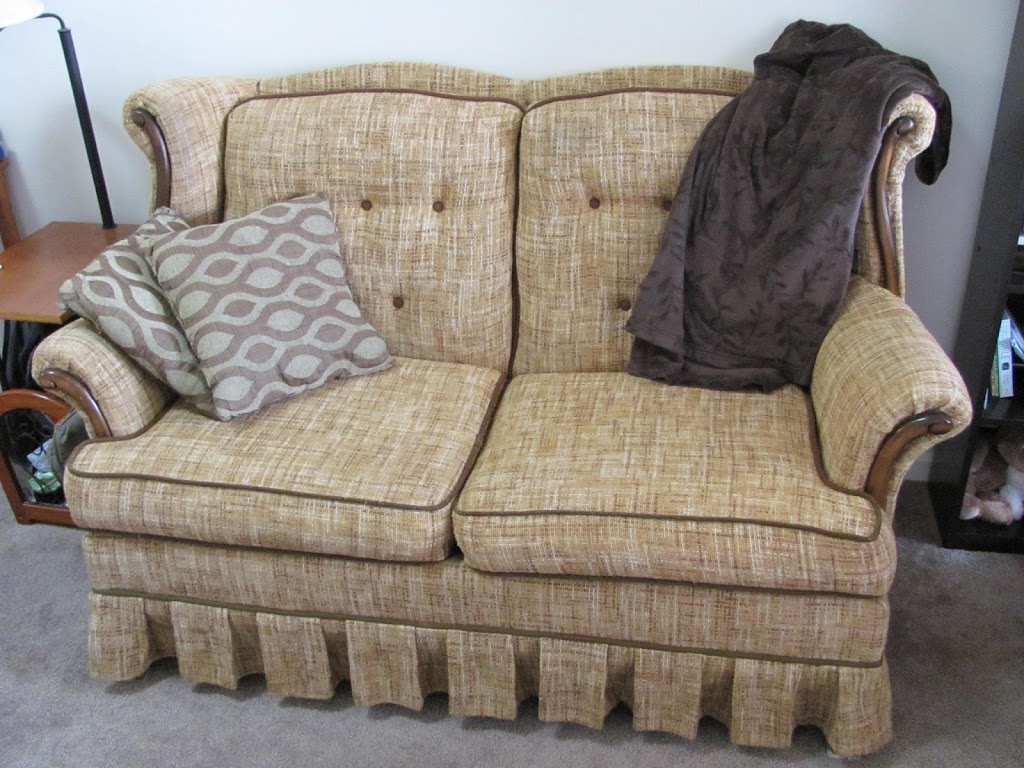
My parents had this sofa and chair when I was a child. They had very likely purchased it when they were first married. Imagine everything that was the 70’s, and you would find it encompassed in this sofa and chair. I don’t know this for certain, but I sort of imagine that they were my parents’ “starter furniture.” A few years later, of course, better furniture was purchased, but the sofa and chair simply migrated to a different room…a “spare room,” as it was called, that switched identities on a regular basis. That sofa and chair, as I recall, stayed with that room through its incarnation as a study just after it had given up its role as a guest room.

I went to college…the furniture was still around. It was covered and altered in appearance, but still there. Soon, the sofa wasn’t so comfortable any longer, but I slept on it once while visiting.

When Karen and I met during grad school and announced our wedding, we began searching for an apartment. Until that point, my bachelor apartments had always been furnished. Now, for the first time, I was looking at the prospect of furnishing an apartment while we were both poor grad students. My parents graciously offered to supply a sofa and chair for our living room. Guess which ones they brought?

Last year, as we were packing our apartment for the move to New England, we were deciding what to sell instead of move. Downsizing, as I’ve said, is a very liberating experience. We, too, had acquired another sofa since we had received the gift of that starter furniture, and now, we decided, the starter furniture had to move on.

That sofa and chair had witnessed my childhood, and witnessed the early years of our marriage, but now had to move on to new adventures.

They didn’t stay together. The chair went to a grad student’s apartment because she had eclectic tastes in furniture. The sofa was a perfect fit for an admissions counselor’s office at a local college. They went their separate ways. Sort of sad, actually, but their adventures are continuing.

Sometimes, I wish that I could look in on them and see how they’re faring.

Silly, I know, and I’m not nearly that sentimentally attached to our furniture, don’t get me wrong. I just think that it would be interesting to personify various things…that small table, or decoration on the wall, or a bedside stand…something that has come through our lives on its way elsewhere…and see what adventures they see, hear what stories they could tell.