Overlooking

Last week, while visiting my fellow-blogger Katherine in Washington, D.C., we had dinner at the Hard Rock Cafe. We did this because…well, because I have to eat at the Hard Rock Cafe whenever it’s an option. I just have to. Otherwise the universe could implode.

Don’t laugh. It could happen.

After dinner, we stepped out onto the corner of E and 10th Streets, and I heard a familiar song drifting toward us:

I applauded at the end of the song. Passersby were dropping tips into the man’s saxophone case. I think I made eye contact with him briefly (it was difficult to tell because of the hat, but he noticed I was taking video), and we walked back to our hotel.

When we were checking out of our hotel the next day, we passed a housekeeping staff in the hallway. She smiled, and we smiled, and said “hello.” Nothing really more than that, but hopefully enough to have some positive effect on her day.

Driving back to Virginia from D.C. that afternoon, Karen and I pulled over at a chain restaurant for dinner. We were famished. As it was still only late afternoon, the restaurant was far from crowded, and we had our choice of seats. I remember the waitress more than the food: she caught my eye. Not in a lusting sort of way, but just in the way that she made eye contact and smiled and genuinely conversed, if only in an attempt to understand our order, and was a very beautiful woman.  What leaves me a bit disconcerted this evening is that I can’t remember her name.

I can come close: I believe it was Rachel, if I had to guess. I just don’t know for certain. I’m not wondering because I wanted her number of anything juvenile like that…I’m not the unfaithful type. And, realistically, I doubt anyone would think less of me for not remembering the name of a woman who waited my table once in my life at a restaurant to which I’ll likely never return.  But it bothers me. The reason it bothers me is because she was engaging, and bright. She wore what looked like an engagement ring. I was just curious about her life, because I wanted her to be in momentary recollection as a fellow human being, not just a woman who waited my table. She has a life, a story, passions, and dreams. They’re none of my business, and I don’t really want to go so far as to know them specifically, but I want to know that she has them. I don’t ever want to forget that. Nor do I want to forget that about the sax player that gifted me with his music, or any of the other people that I encounter on a daily basis that are looked upon, whether we like to admit it or not, as lesser in station because of their jobs, their educational levels, or (God help us) their ancestry or heritage. So often, we treat them as though they were there to serve us menially…as though that were their identity, instead of their employment.

We left tips for the housekeeping staff at our hotel, as well as for the valet who parked and retrieved the car. I once heard it said that how well you tip is the measure of how good a person you are, but I don’t think that it can be reduced to a monetary value. I think that’s just a trite way by which our materialistic culture chooses to try to quantify mutual respect and engagement. We’re culturally conditioned, at the end of the day, to look over certain people, to glance past their humanity. In fact, we’re culturally conditioned to look beyond everyone’s humanity while driving, it seems. I don’t want to look on a fellow human being as being somehow less because their employment involves waiting on me at a restaurant (I’ve been on the other side of the food counter in my life…it alters your perspective), or cleaning the hotel room I’ve just used, or any number of other jobs. Jobs that are respectable employment, that earn a living, and that any of us might find ourselves doing at any point.

A professor friend once spoke to me of the city where she lived while teaching at a certain institution of higher learning. She said that, in that city of which the school took a huge part, there was a great lack of professional employment, and that it was not at all uncommon to have your table waited by someone with a PhD. In fact, I’ve known professors who worked as baristas during the evening to make ends meet. And, lest we forget, the stereotype of the actor waiting tables during the day while they try to sell the screenplay they’ve written on the side exists for a reason.

Employment is a means to an end. Certainly, being able to do what we love is an ideal situation, but all of us will have at least some period of time in which we are not able to do that. Hopefully, those moments will lead us to respect everyone regardless of their perceived position on the social ladder, and not to look down that ladder as time passes.

And, as for the artist, a saxophone solo on the corner is just as valid any symphony. The payment doesn’t have to be with money.
Monuments

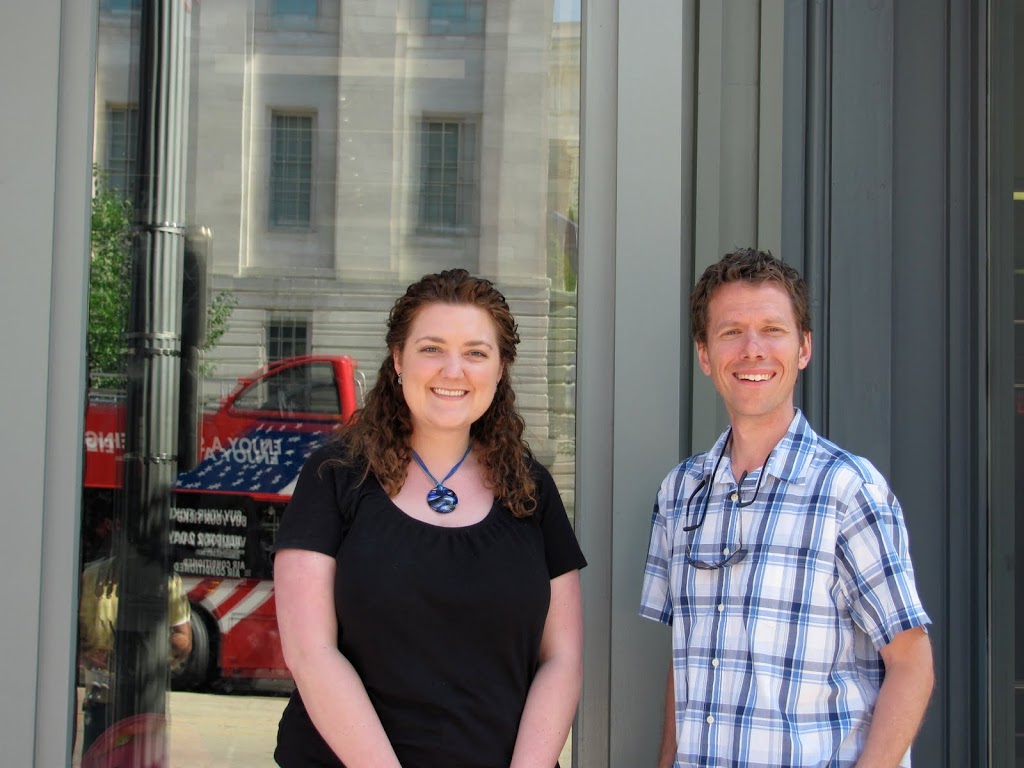
I could count on one hand the number of times I’ve gotten to meet someone in person that I’ve previously only conversed with online. This weekend, I had a chance to meet a long-time fellow-blogger, Katherine, in Washington, D.C. This doesn’t happen very often, and it is a very cool experience to finally meet someone personally that you have known virtually for years. Bloggers, unite!

While we were there, we had a chance to visit, among other things, the International Spy Museum, and several monuments. I’m not going to lie: I wanted to visit the Spy Museum to see James Bond sorts of gadgets. I wasn’t disappointed. As with any museum, you learn a great deal. The experience was an education in history I’ve known and forgotten, history of which I knew little, and history that I’ve never known at all (I am, after all, a product of mostly public education, and we know how well they do history).

The Spy Museum begins by talking about how critical secrets are to governments, and moves to the premise that, in order to understand history, you have to know the history behind the history. Therein is the realm of the spies. The stories of deception and the knowledge that spies look like everyone next to us, as well as how events in history unfolded because of secrets that were leaked, smuggled, and otherwise divulged, moved me beyond my love of intrigue in espionage novels. There’s an exhibit on propaganda that will leave you shaking your head in stunning realization. There’s an exhibit on the formation of the KGB, by whom spying was turned inward for the first time, that will make you cringe.

The next day, Karen and I visited some monuments that she had never seen. I haven’t been to D.C. since I was an undergrad, so the visit was just as impactful for me as it had been the first time. Years ago, I walked the length of the Vietnam Memorial to gain some appreciation for the war into which my father was drafted. Monuments, of course are erected to commemorate a person or an event. For example, the Lincoln Memorial points not only to the President, but also to his positive contributions to American history…a sign, more than a symbol. Enormous crowds of people pressed in on all of the memorials on Monday, in commemoration of Memorial Day, and I imagine many of them being as I was for many years of my life…reading a thankful patriotism into the history with which the monuments connect us. And I’m not saying that’s wrong. I was just left to ponder man’s desire for power, a power gained by keeping secrets, secrets that cause perpetual violence and war. Perhaps those things will always be with us in our mortal lives. I still like the intrigue (The real life Aston Martin was incredible for those of us who are James Bond fans), but knowing that a harsh reality is the basis for the fiction causes me to see past the intrigue, into shadows of a humanity always poising itself for power over itself.

The fiction we can put away when we go to bed at night. The reality is something with which we must always live, and moreso the consequences of that reality. In doing so, perhaps we realize that our monuments portray, at once, both the dark and the light that walk together through history.

Lucid Relocations

So, after a few years, I’ve decided to give unobtrusive lucidity its own address. I’ll be moving the blog over to www.unobtrusivelucidity.com  sometime this week (basically, the same address without the “.blogspot” addition). I’m still hosting with Blogger, and they tell me the current URL will re-direct there automatically. Hopefully, there won’t be any issues for those of you subscribing via a reader or by email. Watch for my regular post next week, and, if it doesn’t appear in your feed or inbox by Tuesday or so, check back and let me know in the comment chain to this post, so I can take care of the issue.

And, if anyone has experience at this sort of thing, feel free to leave advice here, as well!

Thanks for reading!

Money…It’s a Gas…

Long ago, at an institution of higher learning far, far away, while working on my undergrad, I competed in forensics. For those of you unfamiliar with this, forensics is essentially a combination of public speaking and reader’s theatre events that are performed for competition. Teams travel, compete, and winners receive trophies. I still have my trophies from those good times. My choice events were persuasive and after-dinner speaking.

Somewhere during those competitions, I competed in the persuasive category with a speech advocating against lawsuit abuse. The phrase had become a sort of buzzword at the time, and I essentially stood on the grounds that it was a horrible waste of money and time. One of my attention-grabbing examples was of a particular lawsuit over the “intentional infliction of emotional distress.” I remember finding that premise to be absolutely ludicrous.

And now, fast forward to present day…

In March of this year, a lawsuit was settled in West Virginia for a student who had died during gym class. The student apparently suffered from a heart condition. The mother sued both the local board of education and the county government for millions of dollars. Fast forward again to this month. A friend of mine who teaches told me that students at one local school district can no longer run a mile as part of their annual physical fitness test.

Coincidence?

Once a school board is sued for such a huge amount of money, other school boards begin to react in fear, and rightly so. As the American legal system functions primarily on precedent in most states, they could stand to lose most of their financial assets should a similar situation occur. And, as we all know, education isn’t the best funded of our public services in any case. As a result, students are no longer encouraged to by physically active, and are given one more excuse for a victim mentality as yet one more activity is taken away from them. They are taught to be scared that something might happen to them, too, and gym teachers are prevented from doing their jobs because of one tragic event.

Here’s a sad American truth: our legal system causes knee-jerk fear reactions, because it cannot be navigated by the average citizen. A single mistake can result in a lawsuit that can relieve one of their life savings, future wages, and essentially everything else that they own.

Wait…how many of our elected politicians began careers by attending law school? Coincidence?

Okay, okay, before I start sounding like a conspiracy theorist, let me take this back a step further to the core philosophical issue that I think is at play here, an issue that would likely only be found in a capitalist culture. That issue is that a human life cannot be quantified by a monetary figure.

Two summers ago, I was involved in a car accident in which the other party was cited as being at fault. Their insurance paid me money for “pain and suffering.” I found this to be insane. Assuming that I had experienced pain, or that I had suffered, how was money going to change that? This is money that is awarded beyond payment of legitimate medical costs, and is essentially, in my opinion, a form of insurance in itself that they felt would prevent me from suing them for more money. Honestly, I’m still insulted at the unstated assumption that I would that.

Yet many would, because the proceedings that make attorneys their comfortable six-figure salaries also become a form of easy income or revenge for those who think they have been wronged (or can at least convince others that they have been wronged). Thus, the lowest common denominator does enormous damage to the quality of life of everyone else who feel the need to act preventatively lest they be sued, as well.

The loss of a child’s life to a senseless accident is unbelievably tragic, and I grieve for the mother and other family members. Legal consequences in the event of negligence (I’m not implying that this occurred, but merely using the example) would be understandable. Assigning a dollar amount as compensation for a child’s lost life, however, is the height of soulless materialism, because to do so says that a human being has only a finite, measurable worth. The natural conclusion of this would be that some, then, are worth more than others. This is a thought process that is absolutely unacceptable and unethical, yet is perpetuated by our broken legal system each time a lawsuit such as this moves through the channels.

As human beings, we are worth infinitely more than pieces of green paper with arbitrarily assigned numerical values can ever calculate. To pay a mother for the death of her son not only dishonors his memory, but also fails miserably to alleviate any pain or grief. Yet we continue to presume that this is exactly what can be accomplished.

Silly rabbit. When will we learn? The most important aspects of life cannot be purchased.

Photo Attribution: http://www.flickr.com/photos/dborman2/