Definitions and Blogging

It’s not just that I don’t like Facebook, I suddenly realize. I’ve come to the conclusion that I’m just not a huge fan of social networks.

To explain that, though, let me draw the distinction about which I had a recent epiphany. Well, a mini-epiphany, at least:

I’ve determined that I prefer blogging platforms over social networks. And I consider Twitter a blogging platform.
— Dave Brown (@truthscribe722) July 12, 2012

You see, what I love about circulating thoughts through the public sphere is the ability we have to throw our ideas out there for whomever might read them. Perhaps this is just a writer thing, but I don’t think so, because I see the same thing happen with photographers and artists that I know. We put our work or our ideas out for consideration, and then enjoy the conversation that (hopefully) happens as a result. The connections that result from those conversations tend to be good professional networking, and you end up meeting some really fascinating people.

So, back to that distinction. What I love using and participating in are blogging platforms. I was a blogger long before social networks were the norm, and I’m still connected with some of the very bloggers that I began conversations with in that first year of writing here. What I enjoy about connecting with people online are not status updates or location check-ins, although those things can be fun and useful. I enjoy creative expression, people generating things for others to read, watch, or look at, and then discuss. Working with this as a sort of definition, I include platforms that I originally thought of as social networks as blogging platforms, such as Twitter (which is technically referred to as a “micro-blog”), and Tumblr. These can be used as status updates, but are better used in spreading your ideas, your humor, links of interest…in short, your thoughts, not just what you had for dinner.

One weekend, Karen and I were out with friends who are not big social-networkers. I was looking at something online as we were walking up the stairs at an art gallery, when one of them asked me if I was tweeting. “Do you think anyone cares that you’re walking up stairs right now?”, was her question.

That is the danger that social networks fall into, and what gives them a bad reputation, certainly. It is also, I think, what differentiates blogging platforms from social networks.

Social networks have different uses, primarily in keeping in contact with others. As much as I have come to dislike Facebook, I keep an account there because it is still the lowest common denominator: if I want to get in touch with an old friend and aren’t sure where they’ve been for the last year, phone numbers and email addresses can change, but I know that they will have a Facebook page.

And, lest I forget, Facebook has had other positive impacts on my life, as well.

So, hearing what others are up to and where they are at this moment can be interesting, and I enjoy seeing others’ vacation photos. What I really want to see, though, are what they think about things, what they’re reading and why they like or dislike it, what projects they’re working on. That’s why I prefer blogging, and why I think that the speculation of the death of blogging as a medium is vastly over-stated…because the definition of blogging is really bigger than it seems at first blush, don’t you think?

Peering Ahead

I’m a futurist. Or so Karen tells me.

She first coined this particular label for me about two weeks ago, as I recall. She mentioned it during a conversation in which I declared cable television to be an antiquated dinosaur in which few people are actually interested (somehow, when I write that out, it makes me sound like such a snob…). In any case, she used the term in the sense that I readily accept, see the positives in, and embrace changes that alter (positively, in my perception) the human lifestyle, particularly of a technological nature.

That said, what I’ve read and heard about Google’s Glass project makes me a bit uncomfortable.

This afternoon, the three of us went out for a late lunch. I took out my phone to check Twitter, and Karen announced that I had “disengaged.” I became defensive for a moment, but it troubles me that even that briefest of seconds can be just that: disengaging from those around me.

In whatever instance, though, using my phone does disengage me, because I am no longer fully present with the people around me. I attempt to limit this. I intentionally avoid push notifications, at least noisy ones, whenever possible, so that incoming emails and notifications are visible on my screen when I choose to check my phone, but don’t interrupt what I’m doing to grab my attention. I want to see my information when I want to see it…I don’t want it interrupting what I’m doing to tell me when to look at it. I have the luxury of arranging these options on my phone, so that, incoming calls or texts aside, I choose when to look at the device.

Having incoming messages, my Twitter stream, and other “noisy” data appearing as a heads-up display on my sunglasses as I walk down the street? I’ll pass.

There’s a bigger concern, here, though, and that’s the change in the social contract that this sort of technology brings about. I can choose to control or avoid it altogether as far as my usage is concerned, but I cannot control yours. So, if I’m walking down the street and pass someone wearing cyborg glasses that are streaming his point-of-view to YouTube, then I have appeared on YouTube without consenting to do so. When a guy is walking through the parking lot of our apartment complex wearing these glasses, and passes an attractive woman leaving the pool in her bikini, he has a recording of her to consult later as he will. In fact, not only does he have that image, but so does Google, whose motives occasionally raise doubts for me.

Now, legally, I’m not certain how much the law pertains to this, because it hasn’t really caught up with technological trends as of yet. To my knowledge, there is no expectation of privacy in a public space…thus, we can all be recorded by traffic cameras. What about the dinner party we host, however? Do I have the right to ask someone to not use such a device in my home? Even in a public space, I would hope to have some level of control over when and how my likeness is used by my friends.

I make an earnest effort to not post photos of friends without their permission, even at casual events. I have many friends who do the same, and I can think of a handful that prefer to not have their likenesses posted. Perhaps the issue in my mind is one of ethics moreso than legality.

Which raises interesting questions about how these sorts of technological advancements impact our ethics.

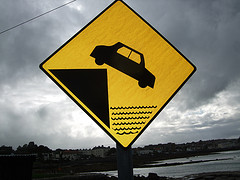
The world is moving quickly. This only becomes dystopian if it leaves us behind.

Photo Attribution: azugaldia under Creative Commons

Directionally Challenged

Karen and I recently became avid watchers of Foyle’s War, a British police drama set during World War II that is both amazing historical commentary, as well as a jarring look into modern culture, all done with top-notch writing and an amazing cast. One of the things that I enjoy about an excellent historical series are the conversations about the period that it sparks. Last night, in the middle of the episode, the iPad was out to consult Wikipedia about some minute detail of law enforcement in the U.K., which of course in turn brings about interesting facts that neither of us knew, and conversation ensues.

Why, yes, we are a bit nerdy that way.

This show does an excellent job of capturing all of the little details of what life was like in the U.K. during the war. One of the details that  caught our attention last night was the fact that they took down the signs providing directions in places like rail stations, so that potential German invaders wouldn’t know which way they were going. Yet, all of the characters knew which train to catch.

The last time I visited New York City, I was never really comfortable with the subway. Had there not been someone in the group (it was Spring Break during my undergrad, if that tells you how long ago I visited) that knew the system, I would have been clueless as to which train to take, maps and signs or not. Of course, this isn’t the case for those who live in the city, but, as an outsider I was clueless. The effect was very disorienting.

Even driving around my own city, though, I rely on GPS to take me somewhere that I’ve never been. I remember thinking, when the GPS became part of our technological arsenal, that the part of my brain that is good with directions must be at risk of atrophy. I rely on turn-by-turn directions to get me across town to an office with which I’m unfamiliar, yet the characters in Foyle’s War knew which train to take with no signage whatsoever.

I wonder if the ubiquitous availability of our data causes parts of our brain to deteriorate from lack of exercise. I don’t just mean with directional signage, though. I mean that the amounts of literature and writings that were once memorized as a common practice aren’t any longer. I have no motivation to memorize facts, quotes, or references, because I can search them out on my phone whenever I need to “remember” them. In fact, I don’t even need to type them out…I can tell my phone to search for them. 

Karen commented once that, upon moving to the South, she noticed that no one knew how to do anything for themselves. That is, in New England, nearly everyone either knows how to repair what just broke on their car, for example, or knows someone who knows how to repair it and is willing to lend a hand. Here, no one even changes their own oil it seems. And I’m just as guilty of that as anyone. While this employs many people in so-called service professions, it also makes us frighteningly unable to be self-reliant in many areas.

When it comes to remembering things, I think we’ve lost a great deal of self-reliance. Since I’m into dystopian scenarios, I have to imagine what we would do if some catastrophic data loss occurred world-wide, leading to crashes of servers and breakdowns of communication. How much would we know? Even when I’m working on a car myself instead of taking it to a shop, I look up what I need to do on Google, and forget it soon after I’ve finished. Without instant access to whatever we need to know, we can’t remember it…which means that we don’t really know it.

Which, by that definition, means that we don’t really know much.

Photo Attribution: SMcGarnigle under Creative Commons

Digital Isolationism

Karen and I had some friends over for dinner tonight. Amongst this particular group of friends, there is a consistent loaning of books and good discussion following those books. In fact, over the years, Karen and I have had to keep a list of what books have been loaned to whom if we ever hoped to hold any chance of seeing their return to our shelves.

And some, let’s be honest, never make it back…but they’ve found a good home, so its not really sad. Its just that we frequently end up replacing those books.

At the outset of the so-called ebook revolution, there was much discussion about what one could and could not do with an ebook. I’ve written about it myself here previously, and I’m not going to re-visit an old topic again. It’s just that during our conversation this evening after our friends left, I commented to Karen that, sadly, loaning is one thing that I wish I could do with an ebook.

And, of course, it is possible with some books, at least through Barnes & Noble…as long as the publisher has the option set up for the ebook (and we know how suspect I find publishers’ motives), and the other person has a Barnes & Noble account, etc. Still, it’s not as simple as just handing someone a book along with a recommendation after dinner.

Karen and I occasionally read books together (it’s rare…usually one of us reads one after the other if we are interested in both reading said book), and are currently doing so. I purchased it as an ebook, and we take turns with the Nook. I had some downtime at an appointment the other day, and read through a couple of chapters on my phone. That’s one of the huge conveniences of the ebook world for me: we can purchase the book once and have the equivalent of multiple copies within the house. Loaning that book, though, becomes more complicated.

I don’t write this to be a technical critique of active or missing features, but rather to point out  the cultural implication that this technological trend sort of sets us up to be an even more individualistic, selfish culture. There’s a sense of ownership of the book and its ideas, and that, if you want to experience those, you need to buy your own copy (again, I’m sure publishers love that idea).

A couple of years ago, Karen and I pondered how to merge our music libraries. The complexity of the task led me to give up. The system is just inherently set up to work with two iTunes accounts under two different machines, or at least two different users, syncing to two separate iPhones. Putting all of our music on one computer only works when we each have a user account on that computer distinct from the other. The infrastructure is set up to work with individuals, not families or groups. This leads to some degree of isolationism, as we think of the family living room in which everyone is engrossed in an iPad or laptop instead of in conversation with each other, or the busy father who can’t put his Blackberry down at the dinner table. There’s a trade-off with all of our technological advances…something we’re giving away in order to gain  convenience.

As much of a futurist as I am,  I sometimes find myself wanting to forego some of that convenience, because the cost in the cost-benefit analysis feels as though it becomes too high.

Photo Attribution: jennifercw under Creative Commons 

Little Bits of Me in Your History

I get the emails at least several times weekly. Often they come from Amazon, or L.L. Bean, or some other online store that I’ve frequented in the past, offering new sales, recommending new items, dressed up in classy design work to make the concept of buying appealing to me.

Some of them are better than others. I buy clothes from L.L. Bean frequently, but that’s about all. Unless it involves beach-combing or the occasional hike, I’m not really the outdoors type. So, when I get an email about a sale on, for example, kayaks, I’m amused a bit.

Amazon tends to be better. Often, I receive book recommendations from them that are already things that I own from elsewhere (I buy more often from Barnes & Noble). What’s specifically interesting are the book recommendations that I receive when I log into Amazon, because they’re an excellent sampling of my reading interests for, say, the past few months, combined with purchases that I made while in grad school. Amazon was my best friend in grad school (this was before I became a Nook owner, and before Amazon treated independent authors as poorly as it now does), because I could save nearly half the cost of a textbook by purchasing it there. Of course, that was all that I had money to purchase, aside from an occasional comic book at the time, so Amazon has a purchase history full of theology and religion texts. One would think that was all I read for three years.

Well, come to think of it…it sort of was, though by pressure of schedule, not choice.

In any case, my point is that, if some secret agency convened around a table in a smoke-filled room, or some alien race hacked into the world’s grid to examine the life of Dave (hey, it could happen), they could gain a wealth of information simply through my purchase histories. I moved from theology texts back to literature, to plays, to science fiction…this was all the process of my settling back into the groove of my natural self after having been displaced for the three years it took me to get that master’s degree.

Similar clues could be gained by sifting through my iTunes purchase history. One could not only quickly discover that I’m a sucker for police procedural dramas and quirky science fiction programs (and we won’t even discuss how many seasons of Cops are currently parked on an extra hard drive), but also see the sort of religious identity crisis in which I spent about two years of my life, based on the music that I purchased.

And I don’t even want to think about how much a certain search engine knows about my life, inspiration, academic plans, and who knows what else.

In fact, if a person can by judged by what he or she reads, listens to, and writes (and I think that’s a fairly safe judgement, as long as those things are looked at in their full scope and not in isolated segments), there are about four online retailers and service providers who, individually, could form a relatively coherent picture of me. With their powers combined, a professional profiler could be out of a job, and I would become suddenly very transparent.

That’s a little frightening when you think about it, and I don’t think that the Internet pioneered this potential for profiled knowledge as much as it perfected what was already there. What I buy for myself, what I buy for gifts (and the people to whom they are shipped) to read, to watch, or to listen to are in large measure descriptive of who I am. And that’s not even bringing social networks into the picture yet, because then the waters can become very murky, indeed.

I don’t think that this is a bad thing: I can opt out of whichever of these emails I choose, and I occasionally see a good recommendation when perusing them. It’s just that when I think of the amount of me that’s accumulated on various servers in the hands of various companies and corporations and private interests…the amount of privacy that I sacrifice for the sake of a certain lifestyle…I suddenly become protective of things. Progressive as I am in my view of technology, I won’t go entirely gently into that good night.

I just don’t know how much to rage against the dying of what quickly becomes antiquity.

Photo Attribution: ajc1 under Creative Commons