Capturing…and Editing…the Moments

Photography is one of those things that I’ve always wished that I had an eye for, but just don’t. When Karen and I visit art galleries, I tend to be drawn to the photography exhibits more than many others. There’s something about capturing real life as it transpires: the hope and pain in people’s faces, the tragedy and comedy of the play of life immortalized in picture. I love seeing the composition that my photographer friends place in their gorgeous images. I love how they transform certain moments by rendering them in black and white. The humanity captured through photography is so evocative.

I guess that’s why I don’t understand the trends I see in my Google + stream, or on Flickr, or on various other social media, in altering digital photographs in such a way that the colors are far too vibrant, far too “touched up” to be real. I see many photographs, and I feel as though I’m watching a classic film suddenly rendered in technicolor.

I’m not against editing photographs. I love the ability that technology has given us to improve our photos. I have forgotten what it was like to not be able to take three shots and choose the one that I want to keep on the spot, or to not be able to deal with red-eye later and save what would otherwise have been a glaring blemish in a photo of a family member or loved one. And all I use is iPhoto.

It’s when a landscape of an exotic location, for example, appears to have been suspiciously optimized for a retina display in a way that real life simply cannot appear, that I have a problem. Are we culturally so given to altering the aesthetics of our natural environment so as to “improve” it that we no longer want to view our landscapes as they really are?

I’m walking in slightly risky territory here, as I’m discussing medium in which I have no ability at all. I just think that there’s a difference between placing a creative lens on immanent beauty, and altering that beauty to something that we perceive as more beautiful.
Wish You Were Here

I’ve been accused of having too many interests in life. Or, as some have phrased it, I still don’t know what to be when I grow up.

What’s that? I’ve already grown up?? When did that happen??? I refuse to accept this…

There are a lot of ways in which having the full plate of interests and subjects about which I’m passionate are good. I have a tendency to never get bored, because there’s always something new to read or a new thing to try in one discipline or another. I have several different perspectives that I can meld into any given pursuit, which, as a sort of Burkian principle, helps me to understand things more thoroughly by seeing them through the lens of something else.

The downside is that I’m frequently disappointed by the fact that I can’t possibly pursue all (or even most) of these interests professionally. As much as I would love to make a living at some of them, I’ve only ever been able to make a living with one or two. So, all of these other interests to which I would devote hours of time if I had unlimited hours in my day are left, by necessity, in the realm of hobby.

As a poet once said, the only thing worse than having a job is not having a job…

Still, occasionally I get the chance to combine vocation and avocation in really cool ways, and that energizes me. And I think that these sorts of events are really important, because they let me have the chance to see one aspect of my life through the lens of another, which helps me to understand it all the more…again, that Burkian principle.

There are also times when I read about amazing conferences or events that I’m bummed because I didn’t get to participate in. That’s life. What I find so amazingly benevolent, though, is that those who did attend them take the time to write out the thoughts and takeaways from those events for the good of the public at large. Reading those recollections are encouraging and helpful to me, and give me the boost I need to be creative, to keep my (slightly loose grip on) sanity, and to just get through the day with my head on my shoulders correctly.

Always a nice thing, that. And, as soon as I’m able to either clone myself or to be in more than one place simultaneously, I’ll make it to more of these events myself.

DIY?

A long time ago, I took an issue with pop music. I wrote a piece for my regular op-ed column with a newspaper at the time about Britney Spears…not in the way that many mocked her, because I don’t want to do that. I was just pointing out that her music was…well, vanilla. Generic. I proposed that playing one of her CD’s and finding where one song ended and the next began would be quite a challenge, because they all sounded the same.

I think that’s the issue with popular culture, is that it plays to the lowest common denominator as far as taste in concerned. For some reason that I can’t fathom, many want only to listen/read/view what’s popular, without probing hidden gems out there that aren’t on the pop culture radar but that have a great deal more substance.

I bring this up because I’m interested in the self-publishing phenomenon. When I finish my current project (the novel I keep talking about here and slowly making progress toward…I think I’ll have it finished by the year 2085 at my current pace), I plan to self-publish. I may change my mind later, but right now I want to go that route. I love how easy it is for authors and artists and photographers and musicians to get their work out there for others, without getting a big business in the middle.

And, for all of us creative types, that’s ultimately what we want: to get our work out there, and hope it impacts others’ lives. Financial success is typically secondary to that.

Still, I wonder what the end result would be if we removed the gatekeepers…that is, traditional publishing houses…from the picture altogether? I say that because sometimes I think we need educated people with good taste working to put high quality literature out there, and keeping some poor quality fluff away from us. Honestly, with so much pop culture vibe going on out there, I’m not sure that the literature that receives the most reviews to become popular would be the highest quality literature. Which would lead one to be concerned that the high-quality stuff would go largely un-noticed after a while.

And, we can’t ignore the fact that some work becomes popular because it’s of such high quality. A Visit From the Good Squad is a great example. This is true for all mediums of artistic expression, as well: U2 has been one of the most popular bands in the world for some time, because of the originality and quality of their art.

As far as publishing is concerned, I’ve heard many say that traditional publishing will never go completely away, and I’m sure that’s true. I think, though, that we’re only years away from having it fade to the background, just as record labels will, I suspect, and perhaps motion picture producers, as well. So what does that mean? How does it impact the overall quality of the literary landscape? What really makes me curious is how it will impact the world of academic publishing, where the review of others in the discipline is absolutely paramount in determining acceptable quality, which in turn has a direct impact on the quality of education that we all receive.

I love watching these changes take place. I’m really interested, and hopeful, that they always take us forward culturally and creatively.

The Nature of a Hero: Behind the Scenes

Those most interesting conversations always seem to happen over coffee when you least expect them.

A friend of mine and I were talking about acting, and the way in which actors can become absorbed in roles to the point of the character beginning to take over. During my undergrad, my training in acting was strongly oriented toward the method-acting school of thought. I’ve experienced the very thin line while acting in which the character truly begins to come to life, and I know that sort of frightening moment when you’re balancing between keeping control yourself instead of permitting the character to take control. Those are the moments in which the performance in the most alive, but also the moments that I honestly believe are the reason that many actors I’ve known and worked with…at least ones that follow this school of acting…sort of aren’t well. Ideally, that’s why actors take breaks…sometimes long breaks…between roles. I haven’t acted in two years after my last serious role, and I remember having to take a long amount of time off after several consecutive roles during college.

Our conversation turned toward the canon of Batman films, and the tragic circumstances of Heath Ledger’s untimely demise following the filming of The Dark Knight. We talked about the discussion that circulated about how the darkly insane character that he performed so astoundingly in that film may have held too much sway over him.

Specifically in the context of super-hero films, this discussion leads to an interesting thought. The most important thing in a story is the through-line, or the overall plot arc. We talked about how difficult it would be to act a role like the Joker, but how it would be so important to do it well, because of the importance of the redemptive message contained within the film as a whole. In that way, the actor portraying the villain is embodying the nature of a hero by being self-sacrificial in order that the greater good may be told…a real-life example of how a hero places his own good below those he or she is serving.

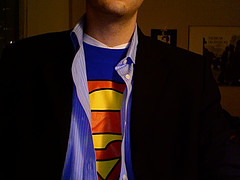
I think that’s one of those opportunities that all of us have to be a hero, and why the inspiration of super-hero mythology is so important to us as a culture.

The Nature of a Hero, Part V

This hero thing just won’t let me go, it seems. What’s more, it keeps popping up in unexpected places, and forcing me to add to my list. Recently, Karen was doing her periodic exploration of new shows to watch and ended up with a program called Eli Stone. The show really didn’t interest me that much, although the premise is, I admit, catchy: an attorney develops a brain aneurysm like what his father had experienced before him, which gifts him with a form of precognition. He realizes that he must use his gift for good, and begins turning from the type of attorney he was in order to help others around him.

Where this becomes interesting is season 2, episode 8, in part of a story arc where Eli chooses to utilize his ability, against the advice of his mentor, to see his own future. He does so because he wants to know what will happen to him, but he deceives himself by saying that he wants to protect his brother. The consequences prove to be dire. At the conclusion of this story arc, Eli says something interesting. He says that the gift he has received (his precognition) is not his own, but belongs to the people around him. That is, the gift is entrusted to him to exercise, but he has recognized that he cannot exercise it for his own good, but must rather place the good of others above himself.

This is a program that is layered with really interesting theological content, and I think that Eli is a hero. The episode I mention here presents what I think is another element of the nature of a hero: the acceptance of the fact that the gifts and abilities of the hero are not given to that person for his/her own use, but for the good of those around him. This is why heroes become self-sacrificial; because they see that, not only are their abilities not for their own good, but that using them for the good of others can easily lead to the risk of the hero’s own life, a risk that the hero accepts. This is why the hero is the hero. The villain and even the antihero make different choices, utilizing their abilities for more selfish purposes.

What’s great about the fact that I found this element in a character such as Eli Stone is that he is an everyman character, and that he does not wear the guise of a hero at all overtly. This proves that those displaying the nature of a hero must not be costumed adventurers, but that all of us can choose to heroically deal with the evils around us. This is what makes the mythology…and the theology…of heroism so important, is because it is so inspirational.

Photo Attribution: Thomas R. Stegelmann under Creative Commons