Overexposure

I like Emily Deschanel. She’s a gifted actor. Even though Bones just isn’t as good a series as it once was, I admire Ms. Deschanel’s talent. I also admire her sister, Zooey Deschanel. Granted, she sounds a little flighty in some interviews, but have you watched her facial expressions when she performs? Her performance was part of what saved The Happening from a lousy script.

I like both of these actors for another reason, as well, though. Because I respect them. The reason I respect them is because they haven’t taken their clothes off or otherwise posed in needlessly provocative photoshoots. Good for them.

I’m not placing them on some sort of pedestal…that’s not my intention. And they’re certainly not alone. Although, they are a member of a minority in not doing so. I’m not certain which of the actors (of both sexes) who refuse to objectify themselves in this way are doing so out of respect for themselves, out of moral stances, out of faith, or may intend to and just haven’t gotten around to it yet. But I admire those who haven’t, nonetheless.

Celebrity is an interesting phenomenon in our culture. Barry Taylor discusses it in Entertainment Theology, stating essentially that culture is something produced, and that the producers make celebrities, the whole thing functioning in a religious sense. With pop culture, celebrities are simultaneously one of us and one of the pantheon of “saints” in the theology of pop culture, and we take possession of them in that way. The audience takes possession of what has been produced, essentially, and determines its value and meaning.

Go ahead, try to wrap your brain around that one and get back to me. The implications are huge.

I think that this leads to us objectifying celebrities. We think we have the right to see a celebrity however we want. We decide if their crises are worth laughing at or ridiculing in order to make us feel better. We’re Romans tossing people to lions for sport, and somehow thinking we have that right because of this twisted celebrity culture we’ve created.

I wonder if the natural result of this isn’t celebrities thinking of themselves as our property. Thus, the only way to maintain celebrity status today (or to regain it when one “isn’t cool” any more), is to pose for a photoshoot that is racy, or (let’s call it what it is) completely pornographic.

Now, pause for a moment, before I really arouse your ire (I may by the end of the post, but not for this, please). I’m not calling all art involving nudity pornographic or objectifying. It is necessary for the story or presentation of theme at times, in many artistic mediums. When done, it can be done either tastefully, or gratuitously…just  like violence in storytelling and visual art. Every time a photographer captures their model in various states of undress, the result is not always objectifying.

It’s just a great deal of the time. Now…let the ire arise.

And, it happens across the board. Recently, an Internet celebrity I follow posed for a men’s magazine. I rolled my eyes. A few years ago, I discovered that a  favorite musician that I had loved since childhood posed nude for playboy. My heart broke. I lost respect for them both. But I also feel really sorry for them both, because one day, they may wake up and wish they hadn’t. And there’s no taking that back.

I admire artists who are focused on their art, placing their effort into their craft, into the stories they are telling and the beauty they are portraying. I respect artists that are not caught up in the celebrity culture and thus don’t feel the need to expose themselves in order to hold popularity. I don’t have the right to see any celebrity I want nude. I don’t own them. I only get to participate (as the audience) in their art…and that is enough.

I heard a co-worker say (about something unrelated) a few weeks ago that, if he can’t be part of the solution, he certainly doesn’t want to be part of the problem. I think we can do both. Visiting the website makes us part of the problem, even if we’re avoiding the “red light” district of the Internet and only browsing paparazzi shots and fan pages. Changing our perspective, and eschewing the multitude of media that capitalizes and commodifies celebrity worship moves toward being part of the solution. Because, let’s be honest: a lot of you are news junkies like myself, but do we really care who’s married to who and who cheated and who got drunk last weekend? I really don’t need to be a drama voyeur…I have enough of my own.

Incidentally, I’m not making this about erotica and the porn industry. That’s a completely separate…and equally abhorrent…problem.

Let’s leave the drama behind, shall we? And let’s respect everyone as we do. Regardless of your faith, there’s something to the Golden Rule. I hope for a culture in which more artists care about their craft and not their celebrity status. To all of them, let me say, I don’t own you, and neither do any of the rest of us.

Please don’t act as though we do.

Photo Attribution: david_shankbone 

Riding into the Sunset. Or Not.

There’s something about the ending to a story.

I remember an undergrad journalism course in which the professor advised us to not irritate our readers. If we do, they tend to not come back. While that is well-intentioned and effective advice for a factual article written in the inverted pyramid, it becomes problematic in fiction. Problematic, but no less true. I’ve read similar advice to writers about the endings of scripts and stories. How the loose ends tie together is key, they say. Upset your audience with the ending, and they tell their friends to not bother seeing or reading your work. Should there be a sequel, they won’t be interested. The ending is critical, and, if Hollywood and much genre fiction are to be believed, must be done in relatively routine ways that border on formulaic (in the case of Hollywood, remove the “border on” from that sentence).

My issue with this is that, if the story is to be true to life, there will be messy and unresolved issues at the end. Because that’s the way life ends. Messy. With unresolved complications.

This is culture informing art, I think, because Western culture just doesn’t grieve well. We don’t accept that death is a part of life, and so we run from it, minimize it, and pretend it doesn’t exist. I can almost see producers around a table in a smoke-filled room saying things like, “Happiness is key, and we all must live happily ever after. Except we don’t. But let’s not tell them about that.”

I recently read this flash fiction piece and thought it appropriate here, because it portrays (rather poignantly, I think) what happens when we don’t permit ourselves to grieve. I’ve talked before about how obscene I’ve witnessed the death process to be in our culture…an emotional barbarity I’ve experienced firsthand. I think that the reason grief is such an alien process to us is because we’ve been taught to avoid it.

Karen commented recently that those mourning a loss are surrounded by well-wishers and supporters initially, for several days or a month or so. Then the supporters phase out and go on with their lives, and the grieving are left in an emotional abyss. That is when they truly need support…I think that is when real friends are proven. There are other causes of grieving, though, than just the loss of a loved one. The loss of a career, the ramifications of poor choices, the ending of a relationship; all leave us entrenched in the grief process. Psychologists will say that this process takes longer for some than others, and that is certainly true. What is clear, though, is that there is no cultural custom built in to assist us in walking through grief, such as other cultures (I think specifically of ancient Israel) have in place. As much as tradition finds itself wanting for me, I can see its value on occasion, and this would be one of those occasions.

The all-too-neat endings of our stories speak to the desire we have for life to end the same way. We like things to resolve the way a chord resolves in music. Yet, true life is closer to the unresolved chords of some jazz musicians, the ugly endings of some indie films, the “artsy abstractness” of literary fiction. I think that there must be a negative before there is a positive in mortal life, that we cannot truly appreciate the positive unless we’ve experienced the negative…the tragedy before the comedy, as Buechner phrased it (and, following his phraseology, I certainly don’t mean to imply that I don’t believe in the fairy tale). Yet, our culture’s stories grasp at an eternal desire for the positive without living nearly long enough in the negative, or else exist solely in the negative and eschew the positive in an attempt to glamorize the negative. This tendency makes for a very unbalanced story.

And that is a symptom of a very unbalanced culture.

Photo Attribution: bensisto 

BLEEP!!!!

I suppose there’s nothing worse than posting something late for a special event, but what I’m posting about was likely unknown to many of you last week (it was to me until someone told me), and…well, I’m on a once-weekly posting schedule here, so you’ll have to look over it.

Last week was National Banned Book Week in the U.S., an event sponsored by the American Library Association and other organizations to draw attention to the harm done by censorship and the still unbelievably common practice of banning books in certain schools and communities. You would be amazed at the books that have been banned in the U.S.: titles and authors ranging from Harry Potter to Shel Silverstein have been deemed dangerous or unfit for reading by children. My imagination immediately invokes images of book burnings through the course of history (I saw a video presentation for National Banned Book Week that contained images of Nazi book burnings), and I immediately leap to frustration at efforts to close down freedom of inquiry and expression. I think it is important to read opposing and unpopular viewpoints, because I’m not sure how one disagrees with something until one understands what that something is.

In fact, I groan at how, very recently, history has repeated itself at some level, this time in the name of protecting state secrets.

As a scholar, as a thinker, as an artist, I will scream from the hilltops that censorship is never, ever okay. I’ll also cry that the public has a right to know, whatever the dirty laundry of our leaders. Banning books and keeping them from the hands of inquisitive readers causes all sorts of adrenaline-laced exasperation to course through me, because it smacks of mind control and propaganda. Everyone should be able to read everything whenever they want. Literature and scholarship must be open to all, and is the property of all.

Unless….

Someone vocalized a rational, opposing viewpoint during a conversation at the end of the week.  That would be that children of certain ages should be prevented from reading certain material in order to protect their innocence. I spat and sputtered for a moment upon hearing that, but when you think of it…none of us would argue against protecting a child’s innocence, would we? The person taking this stance wasn’t advocating for books to be banned, but merely withheld until a certain age…more of a parental function than a governmental function, I think, and perhaps as a tactic of the educational system.

Now, I don’t for a moment think that this metaphor extends to governments keeping secrets from their people, but I can suddenly see the logic of protecting names of vulnerable people that could meet harm or lose their lives should their names be published.

Still, does that merit censorship? I can’t agree that it should. A higher burden of responsibility on the writer, perhaps, and a recognition that servants who place themselves in harm’s way assume the risk that such a thing could happen. Similarly, in the vein of the other argument, I’m not sorry I read anything from my childhood, although I can see how I certainly lost a level of innocence by reading some of the authors that I did.

L’Engle once said that only books with something to say get banned. Franklin spoke against the concept of giving away liberty for the sake of security. I can’t sleep well at night with the idea of advocating the restriction of thought in the name of security or protection. Yet, I can’t sleep well at night with the idea of robbing anyone of whatever innocence they might have left in our bent and industrialized culture. National Banned Book Week leaves me in a bit of a conundrum.

What do you think?

City-Scape Spirituality

Friday night I went see my friend Renee play a show at a local club. I hadn’t been to see one of a her shows in a while, and I love live music, so it was a great way to unwind and begin a weekend. I don’t know what your weekly routine brings you, but my day job is the antithesis of anything inspiring creativity. So, I rush for anything I can to start my synapses firing during my off-time. I got there early and was caught up in the pre-production buzz of sound checks and lighting checks and fog machine tests and cover-charge coordination. I’ve been part of that buzz a lot in my life, and never get tired of it, even in the instances when I’m not directly involved. There’s a rush that happens in the hour before the lights go up on a performance that I’ve never had duplicated anywhere else.

Just after the doors opened and the crowd was beginning to drift in and order their drinks, while only warming lights and fog were on the stage, I sat back in my chair and let my attention wander to the architecture of the place. Another friend owns the club, and he set the place up in a sort of unique space: an old warehouse complex that has been renovated. His club/coffee shop is immediately adjacent to a skating shop, and shares space with a church and a dance school. The ceiling still tells the tale of the industrial origins of the building in its rigging and ductwork and air conditioning units. There’s character in that. On Friday night, the coffee shop lights were dim and the stage lights were up and reflecting off of the fog, giving a unique flavor…a vibe, if you will, or an ambience…to the place.

I love places like this, especially under lighting like that, because it’s about the character and creativity that can be brought out of the old. Call it re-purposing, call it using what’s there, I just think there’s as much (or more) creativity involved in making an old space work for a modern use than in designing and constructing a sleek, modern, new structure. Don’t get me wrong, I love new architectures. I like sleek, modern designs, and I don’t oppose the architect’s art in bringing new life to an urban landscape. But there’s something about the personality of the existing urban landscape that will speak to you if you let it, almost as though its telling you stories of what its walls have seen and about the people who have walked through it.

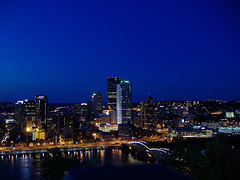
I remember, when I was young, I took a piece of black poster board and some neon paints and began duplicating a magazine layout of a city skyline at night. I loved skylines: the multi-colored lights forming pulsing, living patterns on a dark canvas. I didn’t finish that painting as a child, but ever since I’ve been fascinated by skylines, and will have numerous photos of the skylines of every new city I visit. I think about how, within those skylines, are little places, like where I was Friday night, that comprise the entire living city as a whole: the new and the old living together, sleek and modern architecture side by side with old, industrial spaces that still hold life within them.

Artists still cling to these places…these old, industrial, spiritual places, not constantly desiring the new, not in need of more stuff. They feel the essence that isn’t conveyed by material things. They see…and feel…beyond the seen. They create. That pulse of creation is what I feel when I’m in places like those. It’s what I always feel in the theatre, whether on- or back-stage. It’s a sensation that inspires me simply by virtue of the space I’m in. It’s a buzz I can’t ever grow tired of.

Photo Attribution: Extra Ketchup 

Abbreviated

Just before I began to write this post, I typed out two quick status updates on two different social media platforms. One was a tweet, and I had to re-word and condense the update so that it would meet the 140 character maximum. The other was on Facebook, where I experienced the same problem. In fact, I had to edit the Facebook update twice to get it down to 140 characters.

Because of what I had been writing earlier today, though, I was already in that mode of thinking. I’ve been seeing a lot about the genre of flash fiction lately, and several writers I follow on Twitter have been publishing short pieces that way. Flash fiction is basically a short-short story, ranging anywhere from 500 to 1,500 words, depending on what definition (or which publication) you consult. There’s a market for this, including several science fiction e-zines, and I decided late this week that I would take a shot at my first flash fiction piece this weekend. I mean, its two pages…I write that in just over an hour on most productive evenings, so it can’t be that difficult, right?

Actually, it is. My friend Renee had dinner with Karen and I Friday night, and told us of an odd experience she recently had, laughed about it, and moved on. The experience stood out to me, though, and I saw imaginative, “what if?” sorts of possibilities, so I decided that I had the inspiration for my flash fiction. I wrote it between late Saturday night and Sunday afternoon in two sittings. Part of it is very easy (back story is left out, and only the climax of your plot appears…no rising or falling action). Part of it is deceptively difficult, though: every word of every description has to count, almost like poetry. The theme has to be left for your reader to grasp…you can’t hint strongly at it even if you want to. And character development is minimal to non-existent. At least, those my experiences in my first attempt.

I remember my first semester in grad school, researching a term paper for one of the most difficult classes I’ve ever taken in my academic career. The assignment description from the professor in the class syllabus included a statement that brevity would be considered a valued quality in reading the paper. Essentially, he meant that verbose discussion of a point to take up space wouldn’t be tolerated. I learned to make points succinctly in academic papers, because going over your page limit was not looked upon generously in my graduate program (if they said 30 pages, then, as a rule, you could expect severe grade deductions for turning in 32).

Fiction, though, has always been different for me, because its a free and creative process. I don’t feel constrained by this or that convention (at least not until I start trying to find submission targets). That’s what made this genre a challenge.

But it also makes me a bit uncomfortable.

One magazine that accepted flash fiction submissions stated that the editors considered this the future of fiction, because modern people want quick, short reading material that easily works into the rest of their schedules. The unwritten implication: no one really has time for a novel any more. I’m concerned about that, because I see the same slippery slope that has occurred in the abbreviation of language to make it fit 140 character status updates. I cringe when I see text message language used in status updates (actually, I cringe when I see text message language used anywhere other than text messages). I worry that the English language is devolving instead of evolving.

Writing a story in 1,000 words or less is a challenge that made me think and be creative. Should that word limit become the norm, however, then I think literature will devolve similarly, and we will lose the appreciation for great novels that sometimes reach into the 400-500 page mark. Already, I find myself feeling a bit exasperated when I begin reading a book and discover it to have 400 pages instead of 300. There was a time when I was more interested in the story, and not interested in how long the time to tell it happened to be. Perhaps I’m already infected with the very Andromeda Strain I’m expressing concern about.

So, have we lost our language? Are we losing our literature? Tell me what you think…

Photo Attribution: mpk