A Review of “Sweet Talk” by Stephanie Vaughn

Sweet TalkSweet Talk by Stephanie Vaughn

My rating: 4 of 5 stars

I wasn’t familiar with Stephanie Vaughn prior to hearing her story, “Able, Baker, Charlie, Dog” on the New Yorker fiction podcast. The experience was one in which I remember where I was during the story, one in which I sat in my car after the commute from the office, unable to move until the story had completed. I remember sitting there, in that car, as Gemma looked out over the icy river after her father. “I was his eldest child, and he taught me what he knew,” one of the closing lines of the story, still echoes around my head. I searched out the story that same evening, and purchased this collection simply because of it.

I think the reason that “Able, Baker, Charlie, Dog” caught me so by surprise, struck me so where I live, is because of the intricate, fragile relationship between father and daughter that the story portrays. I read it shortly after the birth of our daughter, and in the midst of attempting to imagine our future and the care with which I was attempting to craft my relationship with her from the beginning, this story was…shaking…to me as Vaughn so clearly painted each character through the other’s eyes.

This collection is filled with just that…moments that are familiar to each of us in some capacity, not in their setting but in their events, capturing the one through the eyes of the other. I found myself examining many of the moments through which I have already traveled, and anticipating those through which I still must, looking to the other individuals that inhabit my own narrative with fresh perspective. The events that Vaughn captures are astounding in their normalcy, familiar in their commonality. There are no moments here in which I found myself closing the book to examine what the author meant. What Vaughn is doing, and what she is doing well, is placing each of us, either retroactively or predictively, into these situations through her characters and giving us the opportunity to explore ourselves.

Vaughn is following the same cast of characters here through various settings and stages of life. I immediately equated this with Salinger’s Nine Stories, but don’t, because, while parallels are easily drawn to the approach, there is nothing nearly as metaphysical going on in Vaughn’s collection. It’s absence is in no way a detractor. Vaughn’s stories are complex but never overwhelming. The timbre of her language resonates with a uniqueness, her prose is concise but never succinct, and always original. Her wit is quick, leaving the reader with a smile but never quite laughing aloud. This is not a lengthy read at just under 200 pages, but you may find yourself spacing it out into a story per evening as I did for over a week. This is because, what I did find myself pondering after each…the relationships in my own life…was worth the time to digest.

I wasn’t aware of Vaughn prior to that podcast. I’m certainly glad that has changed. Sweet Talk is a touching and sincere addition to your shelf that you will find quite necessary.

View all my reviews

Taking Care of the Instrument

Something that Karen had done a lot of before we were married, but that she’s had very little opportunity to do since we’ve been married, is sing. Which is really a shame, because her voice is angelic. And, while I know I’m biased, my opinion is reinforced by the observations of many other neutral parties.

Karen has most often practiced her gifts within a faith community, and, as we were previously heavily involved in theatrical endeavors in the community that we attended before moving to New England, she just simply couldn’t make the scheduling commitments of both work out. Recently, however, she was asked to join the musicians that play for the Saturday night “unplugged” worship service that we attend in our new town. She’s come alive lending her voice to these events. I’ve seen something in my wife that I haven’t seen before, something amazing, something carefree and in love. It’s been amazing to witness.

While I was out at work this Saturday afternoon, Karen told me that she was trying to take a nap while our daughter took hers (the only time that this is possible, as any parent will attest). Her rest was disrupted, she said, by a guy cleaning his car in the parking with screamer music pounding out of his speakers while he worked. That doesn’t make for good resting conditions.

Rock history, as you may know, is a bit of a hobby of mine. I’ve never been particularly attracted to what is alternatively and most commonly referred to a screamer or hardcore music. That’s not to say that I don’t appreciate it. Music expresses the feelings of it’s era, and this genre contains a (quite literal) scream of angst and frustration, a rage against the machine, if you will, at the injustice that is so commonplace around us, the system that fails everyone, and generally being sick of the pain.

There are a handful of hardcore songs that I like, but they are rare. I respect the genre, and what it says about our cultural landscape…it’s just not really my taste. Karen’s opinion of it is slightly stronger.

In her recollection of a nap disrupted tonight, she reasoned out why she dislikes this music. She feels that, despite the urban legend that the screaming vocalists are using “a different part of their voice” and know how to scream without detrimental effect, any of us who have taken vocal lessons know that these vocalists are risking the long-term of effect of destroying their voice. The reason that this bothers Karen, she expressed, is that the musicians are thus not respecting their instrument, and, by extension, are interested only in doing what is popular, not in making true art.

(Umbrella of mercy…I’m summarizing someone else’s thoughts, and likely horribly over-simplifying. It sounded so much more logical when she said it…)

Not certain where I land on this issue. I agree that serious artists respect their instruments. I don’t for a moment buy the myth that these vocalists have learned to scream in a way that isn’t damaging to their voices. I also don’t buy the stereotype of all of these bands…their are hardcore musicians out there doing serious work and saying serious things. The sound is part of the musical landscape, and it says something about our history.

I also think that there are others that capture the angst and the edge with instruments other than their voices.

https://www.youtube.com/watch?v=oIwWqYSbzGA

There’s also something to be said for sacrificing for the art, perhaps. I’m caught in the tension. The message of the sound is important, it says something, it’s an historical marker. The method producing the sound smacks of the amateur sound technician that thinks the way to make the band sound better is by turning everything up. There’s a way to accomplish what’s needed and remain true to one’s art. Sometimes, that’s not at all an easy balance to strike.

In Which I Can’t Forget the Woman Wearing a Trash Bag

The end of this past week was the end of two weeks of scrambling to make deadlines and survive life. The show, as those of us who have worked in the theatre know, must go on, and that’s regardless of complications. You adapt and overcome…it’s just that some things are more difficult to overcome than others.

The thing that’s been most difficult about the transition to making my living in the code of the web is that, with all of the creativity and flexibility that it allows, it is also is a very different frame of mind in many ways. That is to say, I’m an abstract thinker by nature, which is why I’ve always loved academics. The craft of implementing the web…of writing the code…is very concrete. At the end of the day, I just struggle with concrete things. I excel at theories, but don’t always do so great at implementation. All of the tiny details of which I have to keep track during an average day causes a sort of short circuit to occur. I’ve always been able to stay on top of nearly everything in life, to handle the onslaught of tasks and chores that come with being an adult, generally without letting things become overwhelming. I’m the guy who does the dishes every night. For the past six months, I can’t get myself together. There are so many details that require tracking during the day, I can’t handle any more at night. I forget things, important things…like laundry, for example…that I never tripped on before. Organization, I firmly believe, is the key to a calm life, and the combination of the career change, the nature of the career, and having a two-year-old, has resulted in my being just about as disorganized as they come.

All of those things together has left precious little room in my head for the things that I love. I’m rushed, so I don’t always appreciate beautiful things when I see them. I’m forcing myself to think pragmatically, so I miss the “vibe” that I always saw in things before. In my new found vernacular for the technical, I’ve mis-placed a tendency to see the human side of things.

In short, I’m failing to see the miraculous in the mundane.


When I was in college, I read some poems at a public reading that the campus literary journal, in which I had recently been published, held. One of the poems that I read was called “Passerby” (and, to date myself, this was before computers were on our laps and most of us went to the library to write our papers, so I can’t put my hands on this poem easily). The poem was about a woman that I saw one night on a street in New York City. I was leaving a play and walking back to my hotel, and it was raining in the Spring-time and windy, so the city was cold, damp, and it was miserable to be outside. The woman was standing on a street corner, wearing only a trash bag, pleading for money. She was desperate, she was cold…and I kept walking. I was haunted by that moment, which resulted in my writing the poem. I have been haunted by that moment on many occasions since.

The first summer after Karen and I were married, were were in Sacramento for a family wedding. We stopped at a Starbucks for breakfast, and a man was in the parking lot asking for money. I gave him the cash that I had. I liked to think that I had made progress since that night in New York years ago.


At the end of this week, I was rushing to make one last deadline as Karen was texting me details of our daughter, who was sick and had a fever. She needed to me to get medicine to bring home, and I was scrambling on a deadline that I couldn’t miss. As I finally got enough in working order to leave the office and pick up the medicine, I stopped at a traffic light. A woman was standing in the median, holding up a cardboard sign that proclaimed that she was homeless and needed money. I averted my eyes. I didn’t have any cash in my wallet to give her…it’s not like I was refusing to give up what I had. The issue was that I couldn’t think about her. My entire attention was focused on getting what our daughter needed and getting it home. I couldn’t ponder the humanity of that woman’s position. I couldn’t consider it. I didn’t have enough room in my head.

I don’t want to forget those people. I don’t want forget that woman from years ago wearing the trash bag…I pray that she is well and sheltered and with loved ones as I write this, whomever she was. I don’t want to be so absorbed in the insanity that is life in our age that I forget those with whom I am walking the journey. If I do, then I think that I am doing just as much wrong as not pausing that night in New York to even see if I had cash to give. I don’t want to repeat that error.

And I so often fear that I already have.

Not So Super-Sized

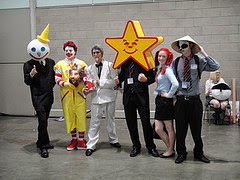
Fast Food Icons: cosplayers as fast food characters

One summer a few years ago, before having our daughter, Karen and I were taking a road trip to visit some family. We left late, after she had finished teaching her night class, and neither of us had eaten dinner. We didn’t want to stop and take time, as we were hoping to arrive at our destination before it could be called tomorrow, so we decided to do something that was quite unusual for us: utilize a drive-through.

We chose Sonic, because, we reasoned in our hungered state, that it was at least slightly better than the evil golden arches and, if eat fast food we must, then it should at least be of some semblance of freshness.

We concluded our road trip with the feeling that we had bricks sitting firmly in our stomachs. And perhaps some concrete. Bleh.

Our family eats out with some degree of regularity, but generally not at fast food places. Part of the reason is that I worked at one (I’ll leave it nameless), and I’ve seen what happens behind the scenes. I’ve seen and handled the frozen burgers before they’re thrown onto the grill for a few moments and then placed on a burger. I seen the grease in which the fries are cooked. I’ve seen the chicken nuggets before they’re cooked. I would have to be pretty desperate to put that garbage into my system, and that’s something upon which Karen and I firmly agree.

When I read the scurfuffle regarding the enormous discrepancy in pay between the CEOs and the front-line workers in the fast food industry a few days ago, I, of course, felt a reaction. I don’t want to talk about the political issue here, though I certainly have my opinion on that. My thought was actually of a conversation that I had with a family member some months ago about how ridiculously fast-paced our lives have become since having children, and how the professional space insists upon consuming more and more of our time. We’re propelled through life at a warp speed that no starship of science fiction stories could ever hope to match. There’s no time to breathe, no time to think, no time to ponder and consider life, and…no time to prepare real food. So, to a window we drive.

The country that gave us the drive-through window, I reasoned, couldn’t ever be accused of being a patient culture.

One of the reasons that these CEOs make such a ridiculous amount of money (and please note that I’m not saying this is the only reason…I’m just leaving the politics out of this space) is that there’s a demand for a quick and easy solution to food. We have no time to cook, so we need something fast. And since so many of us need exactly that, the businesses that provide that fast alternative need a way to provide more of it…you guessed it…faster. That speed, of course, is mutually exclusive of quality.

As I sat down with family over the recent Easter holiday, I was reminded of how important an interpersonal event sharing a meal is. How spiritual an experience. Eating together…which means taking the time to savor the food before us and let our lives weave through each other for an hour or two…is a huge part of the human experience, and always has been. The more of our meals that occur in a car or involve throwing away a bag afterward, the less we get to engage in that experience. That experience is not a pleasure reserved for the wealthy, or the intelligentsia. It’s a part of who we are…a part that we’ve forsaken.

People are very wealthy because our culture can’t take the time to connect, to pause, to enjoy, to socialize.

That’s a part of this story that I fear we’ve overlooked…and a part that makes me quite, quite sad.

Photo Attribution: Doug Kline under Creative Commons

Moonlight Exposition

When I was young, my parents spent a great deal of effort teaching me things. I gravitated toward random trivia and facts. My theory is that this was due in part to the fact that my mother was a science fiction fan (specifically a Trekkie), which caused me to happen onto all sorts of various bits of knowledge. This was stuff that I could out-smart the other kids in class with, so I held onto it. I was the geeky kid who knew the names of all the dinosaurs, and could name all of the comic book characters in the educational comics that the teachers handed out to teach us to not do drugs.

When I was in the second grade, our teacher was teaching a unit on astronomy. Now, I remember precious little about the second grade, and what I do remember is embarrassing, but I fondly remember that day, because the teacher was talking about the moon. I raised my hand and proudly offered my bit of knowledge: the moon doesn’t glow on it’s own, I claimed. It glows because it’s reflecting the sun’s light from the other side of the globe.

The other children scoffed at this outlandish idea. And then the teacher vindicated me, proclaiming that I was correct.

I really like that memory.
Last week, I was unloading our daughter from the car upon arriving home for the evening. It was just dark out, and she pointed up to the sky and, with her (amazingly, profoundly, ridiculously) advanced verbal skills, began to describe to me how the full moon was glowing. And, so, I began explaining to her how it was reflecting the sun’s light from the other side of the globe.
Now, I hold absolutely no misconception that our two-year-old will have learned anything about astronomy that night. After all, night still happens “because the sun has gone to bed.” And those sorts of poetic explanations are far more important right now than any concrete, scientific facts. I loved seeing the world through her eyes in that moment, though…experiencing her wonder as she observes the things that I take for granted. It forces me to notice things again…things to which I had long ago grown de-sensitized. I enjoy explaining these sorts of things to her…the unique and the mundane, but especially the unique…because it’s more about building the habit of doing so at this point, I think.
When I was in the fifth grade (I think this was in the fifth grade), concluding my elementary school career, I remember reading a mystery for a class reading assignment. The teacher asked us to process clues in the story, and come to conclusions about how the crime had been committed. I offered that the glass from the broken window was laying outside the home, and thus someone hadn’t broken the window in, but rather it had been broken from the outside.
Yeah…my geekiness manifested early…
That was another one of those proud moments when I was vindicated by the teacher’s affirmation. I want a lot of those in our daughter’s life, and I think that they begin with Karen and I exposing her to random pieces of knowledge. That knowledge builds on itself. The way that the moon glows is just the beginning.
A very important beginning.
And I’m so privileged to get to share it.