Pressing Pause

Do you remember the episode of Looney Tunes where Bugs Bunny pops up in the middle of a bullfighting ring, and the matador is running feverishly from the bull while Bugs tries to get directions from him? I’ve sort of felt like that this week.

Not that I’ve been spinning my proverbial wheels…I haven’t been. I’ve just been sleep-deprived and feeling as though I’m in constant motion, ticking off tasks on to-do lists and barraged by incoming media.

When I walk up the stairs to our apartment, I have a view over a lot of  treetops from the back of our building. After just getting off of the expressway, finishing a podcast that I had began after reading a few pages in a book earlier in the afternoon before having a conversation with a friend over coffee, and wondering what would be on the flat screen televisions in the gym later this evening when I went to work out, I thought about the constant information intake that I’ve been exposed to this week. Don’t get me wrong, I’ve been producing, also, but I, like the rest of us, have been taking in like crazy, and not all of it good. The afore-mentioned flat screen televisions have been tuned to a satellite radio mix of modern middle-school age hip-hop, and a reality show on MTV, respectively. I feel brain cells die when I think about it.

I looked at the trees tonight, and they were quiet. I think about the quiet, unplugged, amazingly relaxed time at the beach that Karen and I had a few weeks ago. I wish I had more time to just sit and be quiet. I actually do have that time…I just wish that I used the time, allocated the time for that purpose. That’s something I need to be more intentional about doing. Perhaps I’ll go and sit closer to the trees and soak up some of their quiet. Its not the beach, but, hey…its better than reality television.

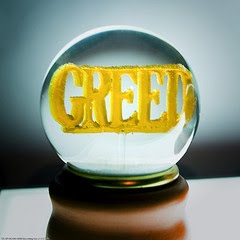
Video Killed…Well….Everything?

Not the first time I’ve talked about this subject….and, I’m sure, it won’t be the last. However, I hit a bit of writer’s block tonight, and went flipping back through that virtual Rolodex of blog posts and articles that I’ve wanted to write a response to, but haven’t quite made the time to do so. And, I rather quickly found this one. Quite a provocative title, don’t you think?

The sentiment of not only the post, but also the comment chain, concerns me. Several commented that perhaps this is the natural time for literary fiction to die, because nobody reads it any more. That stings…and I think that the reason it stings is because I see in it a good deal of truth. Frequently encountering middle-school aged students and seeing the public education system at work on a regular basis, I see a complete void of interest in reading altogether. I think of statistics of how few adults read books for pleasure, and I think of a remark I heard today on a podcast that we are the first culture in the world that has managed to nearly destroy its own poetry. I think about the evolution of media, and how new media is widely viewed (although most would not directly state this) as a substitute for literature, instead of other avenues to explore in addition to literature.

Am I a snob? Am I part of the “literati” who look down their noses at everyone who doesn’t peruse the summer fiction issue of the New Yorker? I hope not. Its just that I see the loss when I think of the great works I read in high school and college, and how many friends and colleagues I encounter who have never read…or in some cases never heard of…novels that have had a profound impact on the way our culture thinks. I don’t even want to say that I’m “well read.” Its just that I’m “somewhat read.”

Obviously, as the huge increase in sales of e-books and e-readers would indicate, novels are not dead, including classic and new literary novels. The blog post I referenced earlier states that genre fiction survives well, and I’m not against genre fiction…I’m particularly a mystery and sci-fi fan. The blogger questions, however, whether or not modern literary writers (who find it easier than ever to get their works in front of the public eye) are of the same calibre as, say, the Tolkiens or Dostoyevskies or Wilsons or O’Connors of previous generations. That is something that I think merits conversation, because the claim that recent decades have yielded no such great writers is not completely without merit, I think (some current and extremely talented writers notwithstanding).

Is it possible for a culture’s tastes and preferences to change so drastically that literature could die, replaced by pulp fiction and genre novels exclusively? Or, as some of the commenters on the original post indicated, does it simply evolve? Do some think that there are not great writers producing work today because others simply think differently as to what is a great work? In other words, does the definition of a great work change over time? If so, is this a loss or a gain? Is it to be expected? Will video kill the author, as well?

What do you think?

Photo Attribution: stuartpilbrow

Drenched

I’m writing this on Tuesday evening, and its raining. Or, rather, it just finished raining. Karen is teaching, and the apartment is quiet. Our end of the apartment complex is heavily populated by local college students. Some of them decided to make a run for the nearby pool for a quick swim between the rains, and, judging from their yells and laughter (there’s one girl whose voice carries a long way), they’re having a blast.

I took a break from reading and wandered over to the window to look down at the parking lot, and noticed this guy who had obviously just returned from his workday. He was sort of trudging the path from his car to the buildings, pulling a rolling briefcase behind him…you know, the kind that remind you of a carry-on bag that you would take on a flight with you. He was in a suit, but his tie was untied and dangling on either side of him, about even with the lapels of his jacket. Off-the-cuff, I’d say he’s in sales. Whatever he does, he had just gotten home at 6:30, and looked exhausted. He was a notable counterpoint to the co-ed, carefree laughter coming from the swimming pool.

I was struck by the thought I’ve often had in the last few years: is that what we go to school for? We spend four years (some of us did the five-year plan) for a college degree, living a great life of free inquiry, exploration, and learning, soaking up all that life has to offer and thriving on it. Our reward is a credential that permits us to enter the workforce with a much-coveted job, from which we return at 6:30, dragging our bag behind us with our ties untied, and looking like we’re already prepared to crawl into bed. Then, we get the privilege of doing it all again tomorrow. Except, then, maybe we’ll get to come home at 7:00 or 8:00.

No wonder they told me that college would be the best years of my life.

I’ve done my time in the 9 to 5 world, and found it wanting. I exerienced freedom again during my graduate studies, and have scrambled to retain it ever since. I think I’m getting close, but I wonder if that’s part of what motivates me to pursue yet another degree, and potentially a life of scholarship. I know that, if it is, its not the only reason…I really see it as one of the few ways that my eccentric little brain can be productive in society. I know that it plays a role, however. My friend, Renee, told me once that she knew long ago that a 9 to 5 wasn’t the life she wanted to live, and took steps early in life to find ways around it. I’m realizing it now, and taking steps of my own. Scholarship might be one of those avenues.

And, if so, then this is me being motivated.  I can’t wait to hit the books.

Snowman Visions

Last week, I finished a book called Oryx and Crake, and dystopian science-fiction novel by Margaret Atwood. I bought it at the recommendation of a friend, and I will now pause to insert the necessary statement to make the monitoring powers happy: I am not reviewing this book for gain, nor have I been offered or am I receiving any compensation by an author or publisher for mentioning it here (this, in fact, is not even a review). The cataclysmic future it portrays is easily imagined…I found myself seeing how we could get there from here without significant effort. In fact, it seems a very possible outcome should we simply keep doing what we’re doing.

The book left me thinking a bit of Lewis‘ warning that, just because we can do something, doesn’t mean we should. On a personal level, there are many things that I am physically capable of doing, and, at my worst, emotionally capable of doing, as well. That doesn’t mean that I should. I think a similar theme…a through-line, to use the theatrical term…can be seen internationally as we seek to dominate the world around us, to beat it into submission when it will not go quietly.

I’m not speaking against the huge advantages that the tools of technology provide us…I’m way too much of a geek to do that. I’m thinking more of the gestures we make to bend the natural to a different image, to make it into not even our image, but one that we think will work for the moment. In doing so, we pollute and waste, we clone and experiment, we do things to ourselves under the guise of “medicine” that should never occur. We cut and splice. We wage war and destroy.

I wonder about decreasing life spans at times, about whether or not we look remarkably different from the way we were designed to look. I wonder about so-called “disorders” of attention and behavior and see immediate connections to how we’ve created them. I think of the enormous prevalence of cancer in the area in which I grew up, and I become nervous, not only for myself, but for my family as well, because I’ve seen the havoc brought about by that particular disease, a disease that I think our waste and pollution is largely responsible for creating. I think of my poor eyesight, that I’m nearly blind without my contact lenses, and how that wouldn’t have been the case had it not been for an overabundance of television screen as a child. I think of the various ailments with which we live every day.

I know that there are scientific explanations, and I know the theological answer to this. At the core of the theological answer, however, is pride, and I think that it is pride that drives us to experiment until we do unwitting damage to ourselves. Yet, without that desire, that urge to improve and move forward, that inherent motivation that drives such experimentation, I shutter to think of where we would be. And its so difficult to nail down: we can’t make the blanket statement that inventions for the sake of convenience are all bad. While some are (the frozen dinners that rot our internal organs with their preservative chemicals), others just make sense (like remote controls and online banking). That said, I still wonder what an atmosphere full of the radio waves that drive the lifestyle to which I’ve become so accustomed causes to happen in the long run? For that matter, I wonder about the effects of an apartment filled with radio waves.

In our quest to invent and create and, ultimately, rule, humans are very bold in  how we push ahead. Perhaps a bit more forethought as to the potential ramifications should be considered. Many of the conveniences I think of lead to significant lifestyle changes, and those lifestyle changes lead to fundamental shifts in metaphysical perspectives (such as a lack of perceived value in a human life), and those shifts in perspective lead easily to the sorts of consequences Atwood envisions.

And twice in the last few months, in two excellent works of science fiction, I’ve seen the prediction of these consequences preceded by the casting aside of artistic expression and spirituality.

When I think about how we shouldn’t do everything of which we are capable, I think of the reasons why we should not. The things that we can do are the realm of the hard sciences, the inventions and discoveries that facilitate us accomplishing what we do. The reasons why we should reconsider potential Pandora’s Boxes are the realm of spirituality, and this is most often communicated (and perhaps best communicated) through the arts. To say that a dystopia on the level of Atwood’s is literally around the corner sounds unrealistic and harsh, perhaps. But I see creative expression cast aside and treated as inferior to the sciences daily (have any teachers lost their jobs in your area lately? I bet the math teachers stayed while the art teachers left). I see spiritual expression (at least that of my own Christian faith) mocked and looked upon as only being divisive and never healing. Ironically, I see the negative emphasized over the positive, while the wonder of new invention is always predicted in terms of the positive at the expense of the potential negatives. Perhaps because that is where the money is to be made, or the power to be gained. In any case, I see our own, custom-crafted dystopia brewing.

Just because we can, doesn’t mean we should.

Photo Attribution: See-ming Lee

Lightning Never Strikes…

When I was young (hold on, I’m about to date myself), cable television was the new convenience that everyone had to have. That was, until our neighbor invested in the next newest thing, satellite television. I remember the huge black satellite dish perched behind their home and aimed to the heavens. I used to look at which direction it pointed, and wonder if that was line-of-sight to the satellite.

I mention all of this because it was one more thing that my father was anxious about in certain situations. To this day, my father won’t let appliances such as washers, driers, or dishwashers operate while the house is empty. He’s concerned about flooding, and fire, and so forth. Fortunately, that’s a concern I’ve managed to leave behind. What still haunts me, however, is his anxiety about thunderstorms. You see, when a thunderstorm occurred during my childhood, everything except lights had to be turned off by Dad’s decree. If you were in the middle of your favorite program, the first flash of lightning meant you were out of luck. The television was turned off, and the coaxial line that connected us to the outside world (which, let’s face it, is what cable was then) had to be unplugged. Not only did it have to be unplugged, the end had to be placed in a glass jar. No, I don’t know why. I just remember that Dad did not want anything being cooked by stray lightning.

The thunderstorm precautions didn’t end there, however. While everyone else in the neighborhood had to stay inside, we were instructed to stay away from windows, as well. Only lights and other essential functions were to remain on. Fortunately, we all enjoyed reading. But, oh how happy I was when we purchased our first VCR, and the pangs of leaving a favorite program mid-episode were no longer to be felt.

In my father’s defense, he experienced some unusually dramatic things during thunderstorms. He spent a career in the telecommunications industry, and for part of that career he was the guy perched atop the poles at the side of the road. He literally had a white fireball of lightning shoot by him as it traced a line once. He’s seen the effects of thunderstorms more than most of us urbanites, and holds a healthy respect for their power as a result.

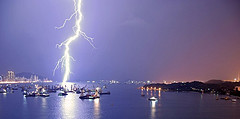
Also as a result, I’m held as sort of odd by most of my friends. I’m thinking and writing this as some relatively severe thunderstorms skirt our area, and I keep looking outside at the darkened sky. Most of my friends love thunderstorms…absolutely love them. They’re entranced by the majestic displays of lightning that split the sky, and when one passes over us, the local Twitterverse is always alive with exclamations of how “epic” and “amazing” the natural light show is as they sit on their decks and patios and take in the view.

Me? I’m sitting inside, away from windows, shutting down the freshly-backed-up computer, and considering unplugging everything from the wall…just the way my Dad would have. Honestly, I think he still does.

To this day, because of the example I grew up observing, thunderstorms make me all kinds of nervous. I wonder if I’m missing out…if they really are as beautiful as all of my friends claim, and if I would be able to appreciate that were I to somehow move beyond the anxiety I feel rumble in my stomach to echo the first rumble of thunder that is audible. No rational explanations help (Karen counts the seconds until the lightning flash, and tells me how many miles away it was…and I just picture the white fireball racing down a telephone or power line and into something valuable, or striking our apartment building outright).

A close friend recently lost some valuable and antique audio equipment during a particularly nasty storm. I took this as justification for my anxiety, although his equipment was not routed through a surge protector, as (you guessed it) all of ours is. I can thank my years as a sound engineer for that precaution. Still, I wish I could sit back and appreciate those awe-inspiring displays of power as they surge overhead as my friends do, free of fear and worry.

And, as for tornadoes, don’t get me started. Watching Twister remains one of the worst mistakes I’ve ever made.

Photo Attribution: moonsheep